PART 2: The Tag Beneath The Collar Told One Story… My Son’s Quiet Words Told Another
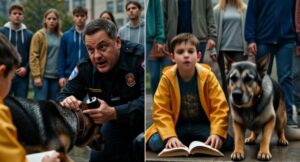
The Animal Services officer stopped moving.
He didn’t remove the collar immediately.
Instead, he carefully turned it over in his hands, brushing away years of dirt and worn leather with his thumb.
“What is it?” someone asked.
He didn’t answer.
His eyes remained fixed on a small brass tag hidden beneath the main identification plate.
It wasn’t a city license.
It wasn’t a rabies tag.
It was military issue.
The officer looked toward a sheriff’s deputy who had just arrived.
“You’d better call Veterans Affairs.”
The crowd exchanged confused glances.
“What does that mean?”
The deputy knelt beside the old German Shepherd and read the tiny engraving aloud.
“K-9 Unit.”
“Sergeant Rex.”
“United States Army.”
The library steps fell completely silent.
The same teenagers who had laughed only minutes earlier slowly lowered their heads.
One quietly deleted the video he’d been recording.
The old dog rested his muzzle on my son’s yellow raincoat.
His breathing was shallow, but calmer now.
Eli never stopped reading.
He stumbled over long words.
Paused when he got nervous.
Started the sentence again.
Each time his voice wavered, the dog opened his eyes just a little wider.
The veterinarian arrived twenty minutes later.
She examined the shepherd carefully before looking up at the officer.
“He’s severely dehydrated.”
“He’s also very old.”
She gently rubbed behind his ears.
“But he’s been cared for.”
She frowned.
“Not recently.”
“But for most of his life.”
Someone in the crowd asked the question everyone was thinking.
“Where’s his owner?”
Nobody knew.
The tag carried no phone number.
Only a service identification number and the dog’s name.
By evening, the sheriff’s office posted photographs online.
Not because the dog was famous.
Because they hoped someone, somewhere, would recognize him.
The story spread much faster than anyone expected.
By sunrise the next morning, reporters stood outside the library.
Television trucks lined the street.
Veterans began arriving carrying faded photographs of military working dogs they’d once served beside.
Most came simply to thank the old shepherd.
Others came because they couldn’t bear the thought of one of those dogs growing old alone.
Late that afternoon, an elderly man slowly stepped out of a pickup truck.
He wore a faded Army cap and leaned heavily on a wooden cane.
The moment he saw the German Shepherd resting beneath a blanket outside the veterinary clinic, his eyes filled with tears.
“Rex.”
The dog’s ears twitched.
Slowly…
Very slowly…
He lifted his head.
His cloudy eyes searched the parking lot.
Then his tail tapped weakly against the blanket.
Once.
Twice.
The old man dropped to his knees despite the pain it clearly caused him.
“I’m sorry, partner.”
“I’ve been looking everywhere.”
No reporter spoke.
No camera operator interrupted.
The reunion belonged entirely to them.
Later we learned the story.
The veteran’s name was Walter Brooks.
Years earlier, worsening Alzheimer’s had forced his family to move him into assisted living.
During the confusion of that transition, Rex had slipped through an open gate while relatives were packing the house.
Everyone searched.
Police.
Neighbors.
Volunteers.
For weeks.
They never found him.
Walter had stopped believing he’d ever see his partner again.
Rex, somehow, had survived alone.
No one knew how many miles he had wandered.
Or how many strangers had unknowingly fed him.
Or why he had finally collapsed outside our town library.
Maybe he had simply reached the end of his strength.
Maybe he had been looking for one more kind voice.
As reporters interviewed Walter, one journalist noticed Eli sitting quietly on a nearby bench with the same children’s book still resting in his lap.
She smiled.
“Can I ask you something?”
Eli nodded.
“Why did you start reading to him yesterday?”
My son looked down at the book.
For a long moment, he didn’t answer.
Then he quietly said,
“Because everyone else was talking about him.”
“I thought someone should talk to him.”
The reporter smiled gently.
“But why read a story?”
Eli shrugged.
“When my dad was in the hospital…”
“…people talked around him.”
“They thought he couldn’t hear.”
His voice became very small.
“But I always read to him.”
A lump formed in my throat.
I’d never known he remembered those afternoons so clearly.
The reporter asked one final question.
“Did you think the dog understood?”
Eli smiled.
“I don’t know.”
“But lonely doesn’t need perfect hearing.”
“It just needs someone who stays.”
The interview aired that evening.
Thousands of people shared it.
Most expected the old military dog to become the story.
Instead…
A frightened little boy with a secondhand library book reminded millions of adults that kindness doesn’t begin with knowing someone’s history.
It begins long before that.
Walter eventually adopted Rex again.
The veterinary bills were paid by donations from people across the country.
The library framed a photograph of Eli sitting on the wet steps, reading aloud while the old shepherd rested beside the bright yellow raincoat.
The picture still hangs near the entrance today.
Whenever people ask me what changed my son after losing his father…
I don’t tell them about therapy.
Or time.
Or grief.
I tell them about the rainy afternoon when an exhausted old dog taught him something I had spent years trying to explain.
That the strongest people aren’t always the loudest ones.
Sometimes…
They’re simply the ones who choose to sit beside someone everyone else has already walked past.