For several long seconds… No one moved.
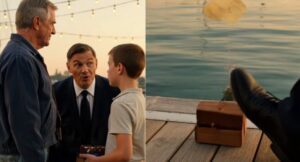
Broken crystal glittered across the dock beneath the string lights while the harbor captain stood perfectly still, his eyes locked on the brass key resting in my grandfather’s weathered hand.
The manager laughed awkwardly.
“Thomas… what are you doing?”
The captain never answered him.
Instead, he took one slow step toward my grandfather.
Then another.
His hands trembled.
“So it wasn’t lost,” he whispered.
Grandpa smiled faintly.
“No.”
“I just stopped carrying it where people could see it.”
The captain let out a shaky breath.
“My God…”
“I thought I’d never see it again.”
The manager frowned.
“What exactly is going on?”
No one responded.
The harbor workers had quietly gathered nearby.
Several older members of the maintenance crew exchanged nervous glances.
One elderly dock mechanic removed his cap.
Another simply stared at Grandpa with his mouth slightly open.
I looked up at my grandfather.
For the first time that evening…
He looked tired.
Not physically.
Emotionally.
Like someone who had spent decades carrying a story he had never intended to tell.
The captain turned toward the manager.
“Pick up that cake.”
The manager blinked.
“What?”
“You heard me.”
“It’s just—”
“Pick.”
“Up.”
“The.”
“Cake.”
There was something in the captain’s voice that silenced the entire marina.
Embarrassed, the manager bent down and carefully lifted what remained of my homemade cake back into its wooden box.
Chocolate frosting covered his expensive sleeves.
No one laughed.
The captain accepted the damaged box with surprising gentleness before handing it back to me.
“I believe this belongs to your grandfather.”
I nodded quietly.
“Thank you.”
Only then did the captain look back at Grandpa.
“I’ve kept your berth empty.”
The manager frowned even harder.
“What berth?”
The captain slowly pointed toward the largest private dock at the end of the marina.
For fifty years it had remained strangely vacant.
Everyone assumed it was reserved for visiting dignitaries.
Or perhaps the club president.
No ordinary member had ever tied a boat there.
“I polish it every spring.”
“I repaint the numbers every winter.”
“I’ve been doing it for thirty-eight years.”
Grandpa lowered his eyes.
“I told you to stop.”
“I couldn’t.”
“It wasn’t mine to erase.”
Guests began whispering.
One elderly woman stepped closer.
“I’ve always wondered why Slip Number One was never used.”
The captain smiled sadly.
“Because it was never abandoned.”
“It was being saved.”
The manager looked completely confused.
“Saved for who?”
The captain looked at Grandpa.
“For the man who built the first dock with his own hands.”
Silence.
Not dramatic.
Simply stunned.
The manager shook his head.
“That’s impossible.”
“The founder’s portrait hangs inside the clubhouse.”
“It isn’t him.”
“No.”
The captain nodded.
“It isn’t.”
“Because he asked us not to paint his face.”
I stared at Grandpa.
“You built this place?”
He chuckled softly.
“No.”
“A lot of people built it.”
“I just happened to be there first.”
Little by little…
The story emerged.
Not from speeches.
Not from documents.
But from the people who had actually lived it.
Before Golden Harbor became a yacht club filled with million-dollar boats, it had been nothing more than an abandoned fishing pier slowly collapsing into the sea.
Most investors refused to touch it.
Storms had destroyed half the docks.
The bank had rejected every loan application.
The town believed the harbor was finished.
Grandpa was thirty years old then.
A commercial fisherman with one boat, two friends, and more determination than money.
Every morning, before heading out to fish, he repaired another section of the old pier.
Sometimes alone.
Sometimes with neighbors.
Sometimes with teenagers looking to earn a free lunch.
The captain laughed quietly.
“He paid everyone the same.”
“How much?”
“A bowl of chowder.”
The older harbor workers smiled.
“He also fixed anyone’s boat.”
“Whether they could pay or not.”
“Half this marina learned to tie knots from Sam.”
Another voice joined in.
“And weld.”
“And repair engines.”
“And survive hurricanes.”
Stories kept coming.
Each one small.
Ordinary.
Human.
No heroic speeches.
No grand announcements.
Just dozens of little kindnesses accumulated over decades.
The manager stood silently listening.
His confidence disappeared with every memory.
Finally he asked,
“If he built the harbor…”
“…why doesn’t anyone know?”
Grandpa looked toward the water.
“Because it stopped belonging to me a long time ago.”
A strong wind carried the smell of salt across the marina.
“I sold my share.”
The captain nodded.
“The winter after the hurricane.”
Everyone nearby remembered.
The storm that had nearly destroyed the harbor decades earlier.
Insurance hadn’t covered the damage.
The club faced bankruptcy.
Members argued for weeks.
Grandpa quietly sold his ownership.
Every dollar went into rebuilding the docks.
He kept nothing.
Not even his office.
Not even his parking space.
Only one thing.
The brass key.
“Why?” I asked softly.
Grandpa smiled.
“Because harbors aren’t supposed to belong to one man.”
“They belong to everyone who comes home safely.”
The captain’s eyes filled with tears.
“You asked us for one favor.”
Grandpa nodded.
“I remember.”
“‘Take my name off everything.'”
“‘If people come here fifty years from now…'”
“‘…let them remember the harbor.'”
“‘Not the fisherman.'”
The manager looked as though the ground had disappeared beneath him.
Slowly…
He removed the event badge hanging around his neck.
“I’m sorry.”
Grandpa studied him for a long moment.
Then shook his head.
“No.”
“You’re embarrassed.”
“Those aren’t always the same thing.”
The manager lowered his eyes.
“I judged you.”
“You judged my boat.”
“And my grandson.”
His voice broke.
“I know.”
I looked down at the crushed cake.
“I’m sorry it got ruined.”
Grandpa smiled.
“It didn’t.”
He carefully opened the box.
The cake had collapsed completely.
The words were crooked.
Chocolate frosting covered almost everything.
He picked up one tiny piece with his fingers.
Tasted it.
Then smiled wider than I’d seen in years.
“It’s perfect.”
The captain suddenly clapped once.
The sound echoed across the dock.
“Bring the table.”
Several harbor workers hurried away.
Within minutes they returned carrying a small wooden table that had clearly seen decades of use.
Someone found fresh plates.
Another brought candles.
One of the pastry chefs quietly carried over a clean serving knife.
Without anyone asking…
The expensive anniversary celebration simply stopped.
The jazz quartet began playing “Happy Birthday.”
Not because it was scheduled.
Because it felt right.
Guests who had laughed earlier now stood shoulder to shoulder with fishermen, mechanics, waiters, and harbor workers.
No one cared that the cake leaned sideways.
Or that the frosting had fingerprints in it.
When the candles were lit, Grandpa looked around the crowd.
“I’ve had prettier cakes.”
He rested one hand on my shoulder.
“But I’ve never had one made with more sacrifice.”
My cheeks turned red.
“I skipped lunch.”
He laughed softly.
“I know.”
“I’ll make sure you never have to skip another one.”
Much later, after the celebration ended and the yachts grew quiet beneath the moonlight, I asked Grandpa why he’d finally shown everyone the brass key after hiding it for so many years.
He looked across the harbor where our little fishing boat rocked gently beside vessels worth millions.
“I didn’t.”
He smiled.
“You did.”
“I did?”
He nodded toward the empty cake box.
“When you cried over that cake…”
“…you reminded me why this harbor existed in the first place.”
“It was never built for people who could afford yachts.”
“It was built so ordinary people would always have somewhere to come home.”
The brass key still hangs around Grandpa’s neck today.
Not because it opens the oldest berth in the marina.
But because every time someone asks about it…
Another generation learns that the strongest foundations are usually laid by people whose names were never carved into stone.