
They Came to My Door With Suitcases and Told Me I Owed Them a Home. My Son’s Silence Made Me Realize I Had Been Paying for His Peace With Mine.
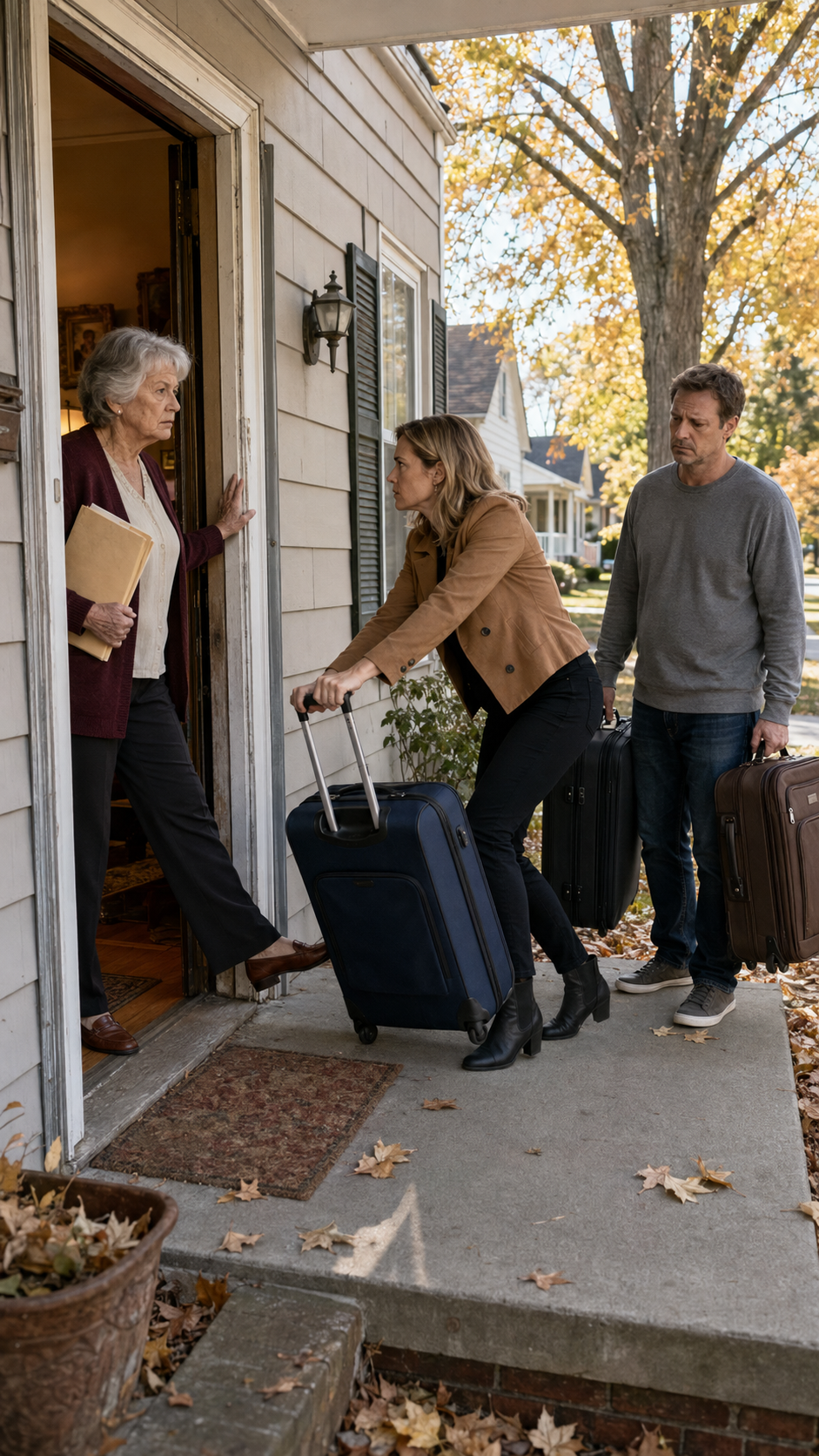
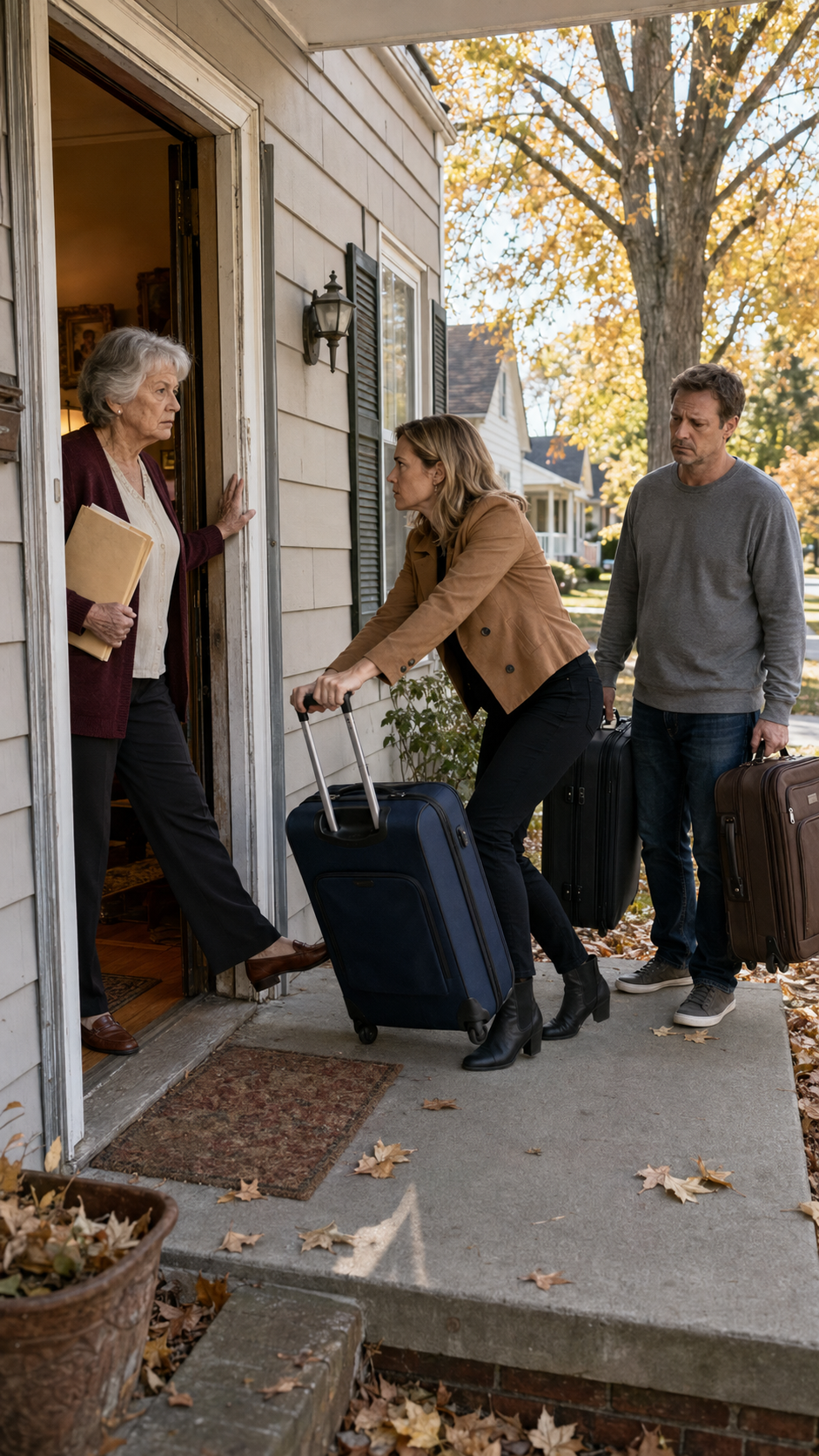
“We’re staying here,” Amanda announced, shoving a navy suitcase toward my open doorway before I had invited anyone inside.
I planted my palm against the doorframe and stopped the suitcase with my shoe.
“No, you’re not.”
For several seconds, nobody moved.
Michael stood behind his wife with another suitcase in each hand. His shoulders sagged beneath a gray sweatshirt, and his eyes remained fixed on the porch boards.
Amanda stared at me like I had answered a simple question incorrectly.
“What did you say?”
“You heard me.”
A suitcase wheel clicked against the wooden threshold.
Across the street, Linda Harper stopped gathering mail from her curbside box. Two doors down, someone’s lawn mower suddenly went silent.
Amanda glanced toward the neighbors before looking back at me. Her lips tightened.
“We just lost everything, Dorothy.”
“I know.”
“And you’re standing there acting like strangers came asking for a hotel room.”
“You arrived with luggage and no invitation.”
Michael finally lifted his head.
“Mom, can we please just go inside?”
“No.”
His expression collapsed.
Amanda gave a short laugh. It contained no humor.
She reached for the suitcase again.
I pressed my foot harder against it.
Her manicured hand froze around the handle.
“Move your foot.”
“Take your suitcase.”
“We have nowhere else.”
“That doesn’t make this decision yours.”
Amanda’s face changed. The worried daughter-in-law disappeared. Something harder replaced her.
She stepped closer until only the threshold separated us.
“After everything, you owe us.”
Michael flinched.
I watched him, waiting for him to object.
He did not.
That silence hurt more than Amanda’s words.
I looked back at her.
“My home is not your rescue plan.”
Her eyes widened.
“Your home?”
“Yes.”
She gave another sharp laugh.
“This family has spent years carrying you.”
“That isn’t true.”
“Oh, please.”
“Amanda,” Michael said.
His warning sounded weak.
She ignored him.
“You’ve always had somewhere to land because Michael never tells you no.”
I looked at my son.
He stared toward the street.
Amanda pointed at the hallway behind me.
“You have three bedrooms.”
“I know how many bedrooms I have.”
“You live alone.”
“That was not an invitation.”
“You’re unbelievable.”
“Maybe.”
Her cheeks reddened.
A light October breeze pushed dry leaves across the sidewalk. The sound seemed unusually loud.
Amanda lowered her voice.
“We sold our house.”
“That was your decision.”
“We trusted a financial plan.”
“That was also your decision.”
Michael swallowed.
“Mom, we made a mistake.”
And there it was.
Not We need help.
Not Can we stay for a few nights while we figure things out?
Not even I’m sorry we showed up like this.
Just the familiar sentence that had opened my wallet, my refrigerator, my guest room, my calendar, and my life for nearly thirty years.
We made a mistake.
And somehow, until that October afternoon, those words had always meant that I was expected to fix it.
This time, I didn’t move my foot.
CHAPTER 1 — THE SUITCASE AT THE DOOR
Michael was forty-three years old.
I had to remind myself of that as he stood on my porch looking suddenly eight.
When he was eight, he had broken a neighbor boy’s window with a baseball and come home pale as flour. His father, Robert, was still alive then. Michael had stood in our kitchen twisting the bottom of his T-shirt while Robert explained that being frightened of consequences did not make consequences disappear.
Michael had cried.
Then he had spent six Saturdays raking Mr. Donnelly’s yard to help pay for the glass.
I remembered being proud of him.
Standing on my porch thirty-five years later, I wondered when I had started confusing helping my son with protecting him from every uncomfortable result of his own decisions.
Amanda folded her arms.
“So what exactly are you suggesting we do?”
“I’m suggesting you take the suitcases back to your car.”
“And then what?”
“That part is yours to figure out.”
Her face became almost colorless.
Michael set his suitcases down.
“Mom.”
There was something in his voice that reached into me automatically.
That was the problem.
For years, one particular tone from Michael could make me abandon whatever boundary I had been preparing to set.
When he was twenty-two, it was the tone he used after maxing out his first credit card.
When he was twenty-seven, it was the tone he used when the apartment he and Amanda wanted required a security deposit they had not saved.
At thirty-one, it was the tone he used after their first daughter, Ellie, was born and Amanda wanted to return to work but daycare cost more than they had expected.
At thirty-six, it was the tone he used when their furnace died three weeks before Christmas.
At forty, it was the tone he used after they refinanced their house because, as Amanda explained, “Everybody does it.”
Each emergency had been different.
The solution had always somehow included me.
“Please,” he said.
I felt my fingers tighten against the doorframe.
Behind me, the house was warm. A pot of vegetable soup simmered on the stove. My reading glasses rested on the small table beside my armchair, where I had left a half-finished library book that morning. Robert’s old brass clock ticked on the mantel.
It was not a large or impressive house.
Three bedrooms, yes.
But nobody looking at the weathered shutters and twenty-year-old maple tree in the front yard would mistake it for wealth.
Robert and I had bought it in 1984 when interest rates were high and Michael was a toddler.
For years we did not have extra money.
The dining-room table had come from my mother.
The curtains in Michael’s childhood bedroom were ones I sewed myself because store-bought ones were too expensive.
Robert built the shelves in the basement.
We refinished the kitchen cabinets twice instead of replacing them.
I taught elementary school for thirty-one years.
Robert repaired heating systems until arthritis forced him into a supervisor’s job.
We paid the mortgage one month at a time.
We raised Michael there.
We argued there.
We laughed there.
We buried two dogs while living there.
Robert died there too, though not in the dramatic way people imagine when they hear such a sentence.
He came home from the hospital after cancer treatment and told me he wanted to sleep in his own bed.
Eleven weeks later, on a quiet February morning, I woke before dawn because his breathing had changed.
By sunrise, he was gone.
That had been six years earlier.
For the first year after Robert died, the house felt enormous.
Then slowly, painfully, it became mine.
Not mine because Robert no longer existed.
Mine because I learned how to inhabit my own life again.
And now Amanda had arrived with a suitcase as if an empty bedroom were an unpaid debt.
“Mom,” Michael repeated. “Can we just talk inside?”
I shook my head.
“If I let the luggage cross this doorway, you’ll consider the conversation over.”
“That’s ridiculous,” Amanda snapped.
“Is it?”
She opened her mouth, then closed it.
Michael rubbed both hands over his face.
“We thought you’d understand.”
“I do understand that you need somewhere to stay.”
“Then—”
“I also understand that you decided I was that somewhere before asking me.”
Amanda looked toward Linda Harper again.
Linda had very carefully become interested in an envelope.
“We should not be doing this out here,” Amanda said.
“You’re right.”
I stepped onto the porch and pulled the door shut behind me.
Her expression was almost comical.
I sat in the wicker chair nearest the railing.
Michael remained standing.
Amanda did too.
“Fine,” she said. “Let’s talk.”
“Start with what happened.”
Michael and Amanda exchanged a glance.
I knew pieces of the story.
Three months earlier, they had sold the four-bedroom colonial they had owned for twelve years.
According to Amanda, the housing market was “at the perfect point.”
They had gained considerable equity, and a man named Bryce Kettering, whom Amanda knew through a friend from the gym, had convinced them that rather than immediately buying another house, they should invest much of the proceeds in what he described as a short-term real-estate opportunity.
They planned to rent for six months, let their money “work,” then purchase something newer.
I had been concerned from the beginning.
Not because I understood complicated investments.
I didn’t.
But I understood sentences that sounded too easy.
Robert had always said, “When somebody explains how your money will grow without explaining how it can disappear, keep your wallet in your pocket.”
I had repeated that to Michael.
Amanda rolled her eyes.
Michael said Bryce knew what he was doing.
I asked whether they had spoken with a licensed financial adviser.
Amanda told me they were adults.
So I let adults make an adult decision.
Now, on my porch, I learned the rest.
The investment had fallen apart.
Some of the money was tied up in a legal dispute.
Some appeared to be gone.
Their six-month rental had ended the previous day. They had expected to close on a townhouse using funds that never arrived.
The landlord had another tenant coming.
They had spent the previous night at a hotel.
“And where are the girls?” I asked.
Michael’s eyes shifted.
“With Amanda’s sister.”
That stopped me.
Ellie was twelve. Sophie was nine.
“Why aren’t you staying with her?”
Amanda’s jaw hardened.
“Rachel has two children and a three-bedroom house.”
“So?”
“So she doesn’t have room.”
I looked toward my own front door.
Three bedrooms.
There it was.
The arithmetic.
Amanda seemed to realize I had understood.
“Your house makes sense,” she said.
“To you.”
“Dorothy, we’re talking about family.”
“We certainly are.”
“You would really make your own son stay in a hotel when you have two empty bedrooms?”
“One bedroom is where I sew.”
She stared at me.
“You’re choosing fabric over Michael?”
“No. I am explaining that rooms are not empty simply because nobody sleeps in them.”
“That is the most selfish thing I have ever heard.”
Michael finally stepped in.
“Amanda, stop.”
She turned on him.
“No, Michael. Your mother needs to hear this.”
I watched my son carefully.
Again, I waited.
Again, he did not tell her she was wrong.
He merely said, “Everybody’s upset.”
Everybody.
That word was another old habit.
Amanda could insult me.
Michael could avoid confronting her.
And somehow the situation became a weather event affecting everybody equally.
I stood.
“You can stay two nights at a motel while you make arrangements.”
“We can’t keep paying motel rates,” Michael said.
“I’ll pay for two nights.”
Amanda laughed again.
“How generous.”
I looked directly at her.
“The offer is for my son.”
Silence.
Michael looked ashamed.
I hated that I wanted to comfort him.
Even then.
Even with his wife standing on my porch telling me I owed her my house, some part of me wanted to take Michael inside, make coffee, cut him a sandwich, and tell him we would sort everything out.
Motherhood is strange that way.
Your child can grow taller than you, earn more than you ever did, raise children of his own, and still some small animal instinct in your body hears distress and runs toward it.
But instincts are not always wisdom.
“No suitcases,” I said.
Michael stared at me.
“Mom, are you serious?”
“Yes.”
“For how long?”
“As long as it takes for you to ask instead of assume.”
Amanda grabbed the navy suitcase.
“Come on, Michael.”
He didn’t move.
She pulled harder.
The wheels bumped down the porch steps one at a time.
Michael picked up the other two.
Before he left, he turned back.
“Dad would have let us in.”
The words struck exactly where he meant them to.
I felt them.
He knew I felt them.
For one second, regret appeared in his face.
Then Amanda called his name from the driveway.
He walked away.
I stood on the porch as their SUV backed into the street.
Linda Harper waited until they turned the corner.
Then she crossed over without pretending she had not seen anything.
Linda was seventy-one, three years older than me, and had lived across the street since 1992.
She climbed the steps slowly and stood beside me.
“You want me to say I didn’t hear any of that?”
“No.”
“You want coffee?”
“Yes.”
“Your house or mine?”
I looked at my front door.
For the first time that afternoon, my knees began to shake.
“Yours.”
We sat at Linda’s kitchen table, where a ceramic rooster had guarded the sugar bowl for as long as I could remember.
I told her what Michael had said about Robert.
Linda listened.
When I finished, she stirred cream into her coffee.
“Robert would have let Michael in,” she said.
I looked up sharply.
She raised one hand.
“For about ten minutes.”
Against my will, I smiled.
Linda continued.
“And then he would’ve asked why a forty-three-year-old man had brought three suitcases to his mother’s house without calling.”
That sounded so much like Robert that my throat tightened.
Linda reached across the table and touched my wrist.
“You know what the worst part was?”
“Amanda?”
“No.”
I knew before she said it.
“Michael letting her speak to you that way.”
I stared into my coffee.
“Yes.”
Because that was the wound beneath everything else.
Amanda’s entitlement angered me.
Michael’s silence broke my heart.
And for the first time, I wondered whether that silence had survived for so many years because I had always made it easy for him.
CHAPTER 2 — ALL THE TIMES I SAID YES
Michael called at 8:14 the next morning.
I know the exact time because I was standing at the kitchen counter slicing an apple when his name appeared on my phone.
I let it ring three times before answering.
That alone felt unnatural.
“Hi, Mom.”
“Good morning.”
His voice was cautious.
“We’re at the Hampton Inn.”
“I know.”
“How?”
“You used the card I gave you for emergencies.”
Silence.
Years earlier, after Robert died, I had given Michael one of my credit cards to keep for genuine emergencies involving the grandchildren.
A hospital.
A stranded car.
Something that required immediate help.
Apparently, checking into a hotel now qualified.
“I was going to tell you.”
“When?”
“We were exhausted last night.”
“How much was the room?”
“Mom.”
“How much?”
“One eighty-nine.”
“For one room?”
“We needed two. The girls came over from Rachel’s.”
I closed my eyes.
“So you put nearly four hundred dollars on my card without asking.”
“We’ll pay you back.”
“When?”
More silence.
That question had a history too.
When Michael was twenty-seven, “We’ll pay you back” had meant eleven months.
When the furnace died, it meant never.
When Sophie needed orthodontic work and their dental coverage was poor, I offered the money freely and expected nothing.
But somewhere along the way, the distinction between a gift and a rescue had disappeared.
“Please stop using the card,” I said.
“What?”
“I’m calling the bank after we hang up.”
“Mom, come on.”
“The card was for emergencies involving the girls.”
“This is an emergency involving the girls.”
“It became one because two adults made a risky financial choice and did not make a backup plan.”
“You don’t have to say it like that.”
“How should I say it?”
He exhaled.
“Can we come over tonight? Without luggage. Just talk.”
I looked through the kitchen window.
The maple tree had lost nearly half its leaves overnight.
“All right.”
“At six?”
“Yes.”
“Amanda too?”
“If she can speak respectfully.”
He said nothing.
“Michael?”
“I heard you.”
After the call, I sat at the kitchen table with half an apple on the cutting board and remembered a Tuesday in 1999.
Michael had been sixteen.
Robert and I had been saving for five years to take a trip to Yellowstone.
Nothing extravagant. We planned to drive, stay in ordinary motels, pack sandwiches in a cooler.
Then Michael was accepted into a summer baseball program that cost far more than we expected.
He wanted it desperately.
Robert and I sat at that same table after Michael went upstairs.
“He’ll remember the baseball program longer than we’ll remember a vacation,” I had said.
Robert looked at me.
“Maybe.”
“What does that mean?”
“It means we’re always deciding that his memory matters more than ours.”
I had been offended.
“What kind of thing is that to say?”
“A true thing.”
We paid for the baseball program.
We never made it to Yellowstone together.
At the time, that decision seemed like parenting.
Maybe it was.
The problem was not one sacrifice.
The problem was that I had made sacrifice my native language, then acted surprised when Michael stopped recognizing it as something that cost me.
That afternoon, I opened the narrow desk drawer where I kept household paperwork.
I was not looking for evidence against anyone.
I was looking because for the first time I wanted to understand my own pattern.
There was a folder labeled MICHAEL.
Inside were old receipts, promissory notes I had never enforced, tuition statements, records of checks.
Five thousand dollars toward his college expenses beyond what we had saved.
Three thousand for the apartment deposit.
Twelve hundred for car repairs.
Eight thousand toward his wedding because Amanda’s parents could not contribute much.
Four thousand after Ellie was born.
Six months of daycare payments when Amanda returned to work.
Two mortgage payments during a difficult year at Michael’s company.
The furnace.
The orthodontist.
Summer camp for the girls one year when Michael said things were “tight.”
Not all of it bothered me.
Some of those checks represented moments I would gladly repeat.
I loved my granddaughters.
I loved my son.
Generosity was not the mistake.
What unsettled me was how often I could remember Michael sounding grateful at first and entitled later.
A favor became a precedent.
A precedent became an expectation.
At six that evening, Michael and Amanda arrived without luggage.
I appreciated that much.
Amanda sat stiffly at my dining-room table.
Michael chose the chair beside her.
I made coffee because I needed something ordinary to do with my hands.
Robert’s chair at the head of the table had remained empty for years.
That night, without planning it, I sat there.
Amanda noticed.
Michael did too.
Nobody commented.
“First,” Michael said, “I’m sorry about yesterday.”
I waited.
He glanced at Amanda.
She stared at her coffee.
“For showing up without asking,” he added.
“Thank you.”
Amanda’s mouth tightened.
Michael nudged her foot beneath the table.
She looked at him, then at me.
“I’m sorry we assumed.”
It was not exactly warm.
But it was an apology.
I accepted it.
Then Michael explained their situation in more detail.
After fees, taxes, paying off their mortgage, and the money they had invested with Bryce’s group, they had far less liquid cash than I expected.
“How much do you have available right now?” I asked.
Amanda looked offended by the question.
“We’re not asking you for money.”
“You’re asking to live here because you cannot afford suitable housing. Money is already part of the conversation.”
Michael answered.
“About seventeen thousand.”
I blinked.
“You have seventeen thousand dollars?”
“For everything,” Amanda said quickly. “Storage, food, legal costs, the girls, deposits—everything.”
“But you’re not penniless.”
“Nobody said we were.”
“You said you had nowhere else.”
“We don’t.”
I leaned back.
“What about an apartment?”
Amanda shook her head.
“We don’t want to sign a twelve-month lease. If the investment funds are released, we could buy again.”
“So you want to avoid a lease.”
“Yes.”
“That is different from having nowhere to go.”
Her eyes narrowed.
“You’re splitting hairs.”
“No. I’m finding the truth inside the emergency.”
Michael rubbed his forehead.
“We thought maybe we could stay here for a few months. Three, maybe four.”
“A few months.”
“Until we know what’s happening.”
“And the girls?”
“With us, obviously.”
That meant four people.
My sewing room would become a bedroom.
The guest room would become another.
The hall bathroom would become theirs.
The refrigerator would fill.
Laundry would multiply.
Cars would crowd the driveway.
Their work schedules, school schedules, meals, arguments, television, friends, and belongings would enter every corner of my life.
I had lived with other people for nearly fifty years.
First my parents and siblings.
Then college roommates.
Then Robert.
Then Michael.
After Robert died, I had spent two miserable years thinking solitude was a punishment.
Eventually, it became a form of peace.
I had forgotten that peace was something worth protecting.
“What would you contribute?” I asked.
Amanda sat straighter.
“To what?”
“Groceries. Utilities.”
She stared at me.
“You would charge your own son rent?”
“I asked what you would contribute.”
“We’re trying to save money.”
“So am I.”
“For what?”
The question came too quickly.
Too naturally.
As though a woman of sixty-eight had no legitimate future expenses because the major events of life were already behind her.
I looked at Amanda.
“For the rest of my life.”
She colored.
“That’s not what I meant.”
“It sounded like it.”
Michael leaned forward.
“Mom, we would help.”
“With how much?”
“We haven’t worked that out.”
“What house rules?”
Amanda laughed once.
“House rules?”
“Yes.”
“We’re adults.”
“So am I.”
“We’re not teenagers coming home after college.”
“Then you understand why four adults cannot share a house without agreements.”
“What kind of agreements?”
I had not planned them.
But once I began, the words came easily.
“A firm move-out date. Contribution to groceries and utilities. No rearranging my furniture without asking. No changing the girls’ school transportation and assuming I’ll handle pickups. No entertaining people here without checking with me. The sewing room remains mine.”
Amanda blinked.
“Then where is Sophie supposed to sleep?”
“With Ellie in the guest room.”
“That room is tiny.”
“It held Michael and three cousins during Christmas of 1994.”
“That was for a weekend.”
“Correct.”
She looked at Michael.
He looked at the table.
Amanda’s voice grew sharp.
“So you want us to pay you, live under rules, put two children in one room, and make sure we don’t inconvenience your sewing?”
I set down my coffee.
“You keep using the word want as if I invited this.”
Silence filled the dining room.
Michael finally said, “What if we gave you five hundred a month?”
“For four people?”
Amanda pushed back her chair.
“This is humiliating.”
I looked at her.
“No. Losing money is frightening. Asking for help is uncomfortable. Neither is humiliating.”
She folded her arms.
“Then what is?”
“Arriving at somebody else’s home and acting as if their resistance is a character flaw.”
Michael closed his eyes.
“Mom.”
“No. We are going to finish this conversation.”
I turned to him.
“Yesterday your wife told me this family has spent years carrying me.”
Amanda muttered, “I was upset.”
“You were specific.”
“I apologized.”
“You apologized for assuming you could move in.”
Michael looked uncomfortable.
Good.
For years, I had protected him from discomfort.
Perhaps discomfort had something to teach him.
“Tell me,” I said. “How exactly have you carried me?”
Amanda’s face hardened again.
Michael answered before she could.
“We haven’t.”
She turned to him.
“Michael.”
“No, Amanda.”
It was the strongest I had heard his voice since they arrived.
He looked at me.
“We haven’t carried you.”
I waited.
He swallowed.
“You helped us more than we helped you.”
Amanda stared at him.
Something in my chest loosened.
Not healed.
Just loosened.
He continued.
“Especially after Dad died, I think I told myself I was doing things for you because I checked in and came over to fix stuff sometimes.”
“You changed a smoke detector last spring.”
His mouth twitched despite himself.
“Yeah.”
“And I fed your dog for nine days in July.”
He actually smiled.
Amanda did not.
Michael looked down.
“I know.”
I studied my son.
“Do you know?”
He nodded slowly.
“I’m starting to.”
We did not settle the housing question that night.
But something important happened.
The conversation stopped being about how many bedrooms I had.
It became about whether having the ability to rescue someone created an obligation to do it.
When they left, Amanda barely said goodbye.
Michael hugged me.
At the door, he whispered, “I am sorry about what I said about Dad.”
I did not immediately tell him it was all right.
Because it wasn’t.
“I know you were angry,” I said.
He looked at me.
“I shouldn’t have said it.”
“No.”
He nodded.
For once, I let an apology remain an apology instead of rushing to erase the thing that made it necessary.
After they drove away, I returned to the dining room.
Robert’s chair sat slightly pulled away from the table.
I rested my hand on its wooden back.
“You would have let him in,” I whispered.
The brass clock ticked from the living room.
Then I remembered Robert at this table years earlier.
We’re always deciding that his memory matters more than ours.
“No,” I said softly.
“You would have made him ask.”
And somewhere between the empty chair and the quiet house, I understood that loving Michael did not require continuing every mistake I had made while raising him.
CHAPTER 3 — WHAT HAPPENED WHEN I STOPPED RESCUING
The next morning, I canceled the emergency credit card.
Michael did not protest.
That surprised me.
Amanda did.
She sent a text at 9:03.
We had to put breakfast and another hotel night on our own card. I hope proving your point was worth it.
I read the message twice.
Then I placed the phone facedown and went outside to rake leaves.
That small action felt revolutionary.
Usually, I would have answered.
I would have explained that I was not trying to punish anyone.
I would have softened the message with an offer.
I would have spent twenty minutes trying to make Amanda feel better about a boundary she disliked.
Instead, I filled three paper lawn bags.
At eleven, Linda came across the street carrying two blueberry muffins.
“I see you’re still alive,” she said.
“Barely. Apparently I caused two adults to purchase breakfast.”
“Monster.”
We ate on my porch.
I showed her Amanda’s message.
Linda read it and handed back the phone.
“Don’t answer.”
“I wasn’t going to.”
She raised both eyebrows.
“I’m witnessing history.”
I laughed.
The truth was that setting boundaries did not make me feel powerful.
At first, it made me feel guilty.
That is something people rarely admit.
When you have spent decades being the reliable one, saying no does not immediately feel like freedom.
It feels like neglect.
Your mind produces pictures.
Your son tired in a hotel room.
Your granddaughters eating cereal from paper bowls.
Your daughter-in-law whispering that you do not care.
You have to remind yourself that discomfort is not danger.
Nobody was starving.
Nobody was on the street.
Michael had a job managing logistics for a regional building-supply company. Amanda worked four days a week at a dental office.
They had savings.
They had credit.
They had choices they disliked.
That was not the same as having no choices.
Two days later, Ellie called me after school.
“Grandma?”
Her voice sounded small.
“Hello, sweetheart.”
“Are you mad at us?”
The question cut through me.
“No. Absolutely not.”
“Mom said things are complicated.”
“They are.”
“Are we not allowed at your house?”
I closed my eyes.
“You and Sophie are always welcome to visit me.”
“To stay?”
There it was.
I chose my words carefully.
“You girls are not the problem. The adults are working out where everybody is going to live.”
“Mom said you have space.”
Children hear everything.
Especially the things adults pretend are private.
“I have rooms,” I said. “That doesn’t always mean I have space for four people to move in.”
She was quiet.
Then she asked, “Is Grandpa’s room still the sewing room?”
I smiled.
Ellie had called it Grandpa’s room when she was little because after Robert retired, he used the smallest bedroom as a place to keep fishing gear, tools he was repairing, and an old desk where he paid bills.
After his death, I avoided the room for nearly three years.
Then one winter I took a quilting class at the community center.
I cleared the fishing catalogs.
Moved Robert’s desk beneath the window.
Bought a secondhand sewing machine.
The first quilt I completed was crooked.
The second was less crooked.
By the fourth, I was good enough to give one to Ellie for her tenth birthday.
“Yes,” I said. “It’s still my sewing room.”
“Mom says sewing is something you can do anywhere.”
I inhaled slowly.
“Well, your mother and I disagree.”
Another pause.
“I like that room.”
“So do I.”
“Are you making anything now?”
“A quilt for the church winter drive.”
“What color?”
That was all it took.
Within a minute, we were talking about fabric instead of adult problems.
Before hanging up, Ellie said, “I miss you.”
“I miss you too.”
“When everything gets normal, can I sleep over?”
“Yes.”
Then I added, “And you don’t have to wait for everything to be normal.”
That weekend, I called Michael and invited the girls to spend Saturday night.
He brought them over himself.
Amanda stayed in the car.
The girls ran through the door with backpacks and sleeping bags.
Sophie hugged me so hard I staggered.
For the next twenty-four hours, the house felt full in the best way.
We made grilled cheese.
Ellie helped me sort fabric.
Sophie found a jigsaw puzzle in the hall closet.
At breakfast Sunday, Ellie asked why adults sometimes “make one problem into five problems.”
I nearly choked on my coffee.
“What makes you ask that?”
She shrugged.
“Dad said the money problem is one problem. Mom said your house is another problem. Then they fought about Aunt Rachel. Then Dad got mad about the hotel.”
I looked at her carefully.
“Adults aren’t always very good at keeping problems separate.”
She nodded as if this confirmed something she had suspected.
Sophie poured too much syrup onto her pancake.
“Mom says Dad should stand up to you.”
Ellie kicked her sister under the table.
“Ow!”
“Sophie.”
“What? She did.”
I placed my fork down.
“Listen to me, both of you. You do not need to take sides.”
“We’re not,” Ellie said quickly.
“Good. Your parents love you. I love you. The adults disagreeing does not change that.”
Sophie frowned.
“Are you and Mom enemies?”
“No.”
“She says you never liked her.”
That hurt because it was not true.
Amanda and I had not always been close, but there had been years when we were good.
When she was pregnant with Ellie, I drove her to three prenatal appointments because Michael could not leave work.
When her own mother had knee surgery in Arizona, Amanda spent Thanksgiving with me in the kitchen, learning Robert’s mother’s stuffing recipe.
We laughed because she kept adding sage too aggressively.
For Christmas that year, I gave her the handwritten recipe card in a small frame.
She cried.
There had been affection once.
But entitlement rarely arrives all at once.
It grows around repeated favors until both people forget the favors were voluntary.
“I liked your mother very much,” I said. “I still care about her.”
“Then why are you fighting?”
“Because caring about someone and agreeing with them are different things.”
Ellie seemed satisfied.
Sophie was more interested in syrup.
When Michael picked them up Sunday afternoon, he looked exhausted.
We stood beside his car while the girls buckled themselves in.
“How’s the hotel?”
“Expensive.”
“I imagine.”
He shoved his hands into his jacket pockets.
“We found a furnished apartment.”
“That sounds promising.”
“Month-to-month. Two bedrooms.”
“Good.”
His eyes narrowed slightly, almost as though he had expected me to object.
“How much?”
“Twenty-six hundred.”
I whistled.
“That’s high.”
“Yeah.”
“But you can afford it for a while.”
“We can. We just wanted to avoid burning through savings.”
I looked at him.
“And having four people live here would help you preserve yours by costing me some of mine.”
He looked away.
“When you say it that way…”
“How else should I say it?”
He gave a tired laugh.
“I’m learning not to ask you that.”
Then his expression changed.
“Mom, Amanda is really angry.”
“I know.”
“She thinks you’re punishing us for making a bad investment.”
“I’m not.”
“I told her that.”
“Did you?”
“Yes.”
It was a small sentence.
But it mattered.
He leaned against the car.
“She keeps saying parents are supposed to help their kids when they’re in trouble.”
“Do you agree?”
He thought for a long moment.
“I think parents help when they can.”
“So do I.”
“But…”
“But help and surrender are different.”
He looked at me.
“Yes.”
The word came quietly.
I felt something inside me shift.
Not triumph.
Hope.
“Michael, I would have considered letting you stay here temporarily if you had called and asked me like I was a person whose life mattered.”
His eyes filled before he looked away.
“I know.”
“No, let me finish.”
He nodded.
“You showed up with three suitcases. Amanda pointed at my bedrooms. When I objected, you stood there.”
He rubbed his jaw.
“I didn’t know what to say.”
“You could have said, ‘Amanda, this is Mom’s house.’”
He winced.
“I know.”
“You could have said, ‘We should have asked.’”
“I know.”
“You could have said anything that made it clear you saw me standing in my own doorway.”
His eyes came back to mine.
That was the truth of it.
I had not felt seen.
Not as his mother.
Not as a widow.
Not as a sixty-eight-year-old woman who had spent six years rebuilding a life after losing the man she had loved since she was twenty-four.
I had been reduced to square footage.
Three bedrooms.
One occupant.
Therefore available.
“I’m sorry,” Michael said.
This time the apology sounded different.
I believed him.
“I accept that.”
He nodded.
Then he looked toward the house.
“Dad really loved this place.”
“Yes.”
“I think I stopped thinking of it as yours.”
I said nothing.
He continued.
“It was always just home.”
“That sounds sweet until people think home means nobody has to knock.”
A sad smile crossed his face.
“Fair.”
The girls waved from the car.
Michael opened the driver’s door.
“Mom?”
“Yes?”
“We’re taking the apartment.”
“Good.”
“Amanda thinks it’s a mistake.”
“It may be expensive.”
“She thinks we should save the money.”
“She is allowed to think that.”
He stared at me for a moment.
Then he nodded.
For the first time since the suitcase struck my threshold, I saw my adult son instead of the boy I had always rescued.
He was frightened.
He was embarrassed.
He was caught between his wife’s anger and his mother’s changed expectations.
And he was going to have to solve that problem himself.
I went inside.
I did not write him a check.
That was the moment everything began to change.
CHAPTER 4 — THE COST OF A QUIET LIFE
Michael and Amanda moved into the furnished apartment the following Tuesday.
It was twelve minutes from the girls’ school and twenty-five minutes from my house.
The apartment had beige walls, cheap lamps, and a kitchen table that wobbled.
Amanda hated it.
I knew because she told me.
Not directly.
For three weeks, she communicated mostly through the family group text, where remarks were technically addressed to everybody while clearly intended for one person.
Another night listening to the people upstairs. Miss having an actual home.
Amazing how quickly savings disappear when you’re paying temporary housing costs.
Girls are having a hard time sharing a room.
I did not respond.
Michael called every few days.
Our conversations were awkward at first.
Then something unexpected happened.
We started talking about things other than emergencies.
His work.
The girls.
A book I was reading.
A strange knocking noise in his car.
One Thursday he called just to tell me he had driven past a diner advertising liver and onions.
“Made me think of Dad.”
“Your father would have stopped.”
“I know.”
“He would have ordered it and then complained they overcooked the onions.”
Michael laughed.
It was the first easy laugh between us in weeks.
Amanda did not come to my house for nearly a month.
During that month, I learned things about myself.
I learned that the hall closet was easier to organize when four people’s coats were not suddenly arriving.
I learned I liked having coffee alone at six-thirty in the morning.
I learned I no longer wanted the television on simply because silence felt too much like grief.
I learned that the sewing room had become far more important to me than I had realized.
Not because of fabric.
Because it represented something I had built after Robert.
For years after his death, people asked what I was going to do.
Stay in the house?
Sell it?
Travel?
Move closer to Michael?
Join a grief group?
Date?
Volunteer?
Everybody seemed convinced widowhood required a plan.
I had not had one.
I just survived one day, then another.
The sewing room was the first decision that had belonged entirely to my new life.
The first time I moved Robert’s fishing tackle from the closet, I cried so hard I had to sit on the floor.
Then I found one of his old notes taped inside a tackle box.
DOROTHY — DO NOT THROW OUT THE GREEN LURES. THEY ARE NOT JUNK.
I laughed while crying.
I kept two green lures.
They still hung from a corkboard beside my sewing machine.
One Saturday morning, Linda and I drove to a craft fair two towns over.
On the way home, she said, “You seem lighter.”
“I’ve lost three pounds.”
“That is not what I meant.”
I knew.
“I think I’m angry at myself.”
“For what?”
“For teaching Michael that I would always fix things.”
Linda kept her eyes on the road.
“You taught him you loved him.”
“I also taught him that my resources had no edges.”
“That part you can change.”
“I should have changed it twenty years ago.”
“You were busy being twenty years younger.”
I smiled.
Linda had a gift for making obvious things sound wise.
Then she said, “You know, Dorothy, there’s a difference between regretting your old choices and using them to punish yourself.”
I looked out at the trees rushing past.
Autumn had turned the hills copper and gold.
“I don’t want to become stingy.”
“Then don’t.”
“I don’t want Michael to think he can never ask me for help.”
“Then tell him he can ask.”
“I just want him to understand that asking doesn’t mean I have to say yes.”
“There you go.”
It sounded simple when Linda said it.
Living it was harder.
The real test came a week before Thanksgiving.
For twenty-six years, I had hosted Thanksgiving.
Even the year Robert was undergoing chemotherapy, we insisted on having everybody.
He sat at the end of the table under a blanket, thinner than he wanted anyone to notice.
After dinner, he whispered that my turkey was dry.
I told him cancer had made him rude.
He said, “No, Dot. Your turkey has always been dry.”
I laughed so hard I cried.
After he died, I kept hosting because stopping felt like losing him again.
Michael and Amanda.
The girls.
Sometimes Linda.
Sometimes Amanda’s sister Rachel and her family.
The dining table stretched into the living room with borrowed folding tables.
I used my mother’s white serving platter.
Robert’s favorite cranberry sauce came from a can and slid onto a dish in one wobbling cylinder because he refused to eat the homemade kind.
Thanksgiving was not just a meal.
It was architecture.
It held the family together.
At least I had believed it did.
Michael called on November 16.
“What’s the plan for Thanksgiving?”
I stood at the sink looking out at bare maple branches.
“I’m not hosting.”
Silence.
Then, “This year?”
“Yes.”
“Are you sick?”
“No.”
“Is something wrong?”
“No.”
Another pause.
“So… what are we doing?”
“I don’t know what you’re doing.”
He actually laughed, then stopped when he realized I was serious.
“Mom.”
“I’m having dinner with Linda.”
“On Thanksgiving?”
“Yes.”
“Where?”
“Her house.”
“Just you two?”
“Her brother is coming. Maybe her niece.”
He sounded genuinely disoriented.
“But you always host.”
“I know.”
“Do you not want us there?”
“That isn’t the reason.”
“Then what is?”
I dried my hands.
“I have spent every Thanksgiving since I was forty-two planning, shopping, cooking, cleaning, making beds, coordinating arrivals, and packing leftovers.”
“Dad helped.”
“Your father carved the turkey and opened wine.”
Michael was quiet.
“I like hosting,” I continued. “Or I used to. But this year I don’t want to.”
“What about the girls?”
“You and Amanda can create a Thanksgiving for them.”
He exhaled.
“Amanda is going to think this is about the apartment.”
“What Amanda thinks is not something I can manage for her.”
“Mom, come on.”
There was that tone.
I felt the old reflex.
Fix the discomfort.
Offer a compromise.
Invite everyone.
I waited until it passed.
“I’m not hosting.”
He was silent for several seconds.
Then he said, “Okay.”
Just that.
Okay.
I nearly cried from the relief of hearing it.
Thanksgiving morning, I woke at seven.
For several minutes I lay in bed feeling that I had forgotten something.
Then I remembered.
Nothing.
I had forgotten nothing because nothing was required of me.
No turkey needed basting.
No extra chairs needed unfolding.
No potatoes waited to be peeled.
I made coffee and watched the Macy’s parade in my robe.
At ten, Sophie called.
“Grandma, Dad burned the rolls.”
“In the morning?”
“He said he wanted to test them.”
I laughed.
“Smart man.”
“They’re black.”
“Less smart.”
In the background I heard Michael protest.
Then Ellie took the phone.
“Mom is making stuffing from your recipe.”
I paused.
“My recipe?”
“The one in the frame.”
The framed recipe card I had given Amanda thirteen years earlier.
Something moved in me.
“Tell her to use less sage than she thinks she needs.”
Amanda’s voice came faintly through the phone.
“I heard that.”
I smiled despite myself.
“Happy Thanksgiving, Amanda.”
There was a pause.
Then she said, “Happy Thanksgiving, Dorothy.”
No apology.
No reconciliation.
But no sharpness either.
Linda’s Thanksgiving was small.
Her brother Earl told the same fishing story twice.
Her niece brought a pecan pie that collapsed in the center.
Nobody cared.
At five, we sat in Linda’s living room drinking coffee.
Snow began falling in thin, uncertain flakes.
My phone buzzed.
Michael had sent a photograph.
The four of them stood behind the wobbling apartment table.
The turkey was badly carved.
The girls were laughing.
Amanda looked tired.
Michael’s shirt had a gravy stain.
Beneath the photograph he wrote:
We survived. Turkey actually wasn’t bad. Miss you. Love you.
I looked at the picture for a long time.
Then I typed:
Love you too. I’m glad you made your own day.
That night, alone in my house, I expected sadness.
Instead, I felt something gentler.
The family had eaten without me.
Nobody had fallen apart.
The tradition had changed.
It had not died.
For years, I had believed that if I stopped holding everything, everything would drop.
But perhaps I had been holding so tightly that nobody else had learned to carry anything.
CHAPTER 5 — THE ROOM THEY THOUGHT WAS EMPTY
The financial mess involving Bryce Kettering did not disappear.
Real life rarely offers clean endings on schedule.
By December, Michael and Amanda knew they would recover some of their investment but probably not all of it.
Their attorney believed a settlement might take months.
The townhouse they had hoped to buy was long gone.
They remained in the furnished apartment.
Something else changed too.
Michael began looking at their finances in a way he apparently never had before.
He called one evening while I was hanging Christmas ornaments.
“Did you know we spent eleven thousand dollars eating out last year?”
I nearly dropped a glass snowman.
“In one year?”
“I’m ashamed to say yes.”
“What were you eating, gold?”
He laughed.
“Apparently.”
“Does Amanda know?”
“She’s the one who added it up.”
That surprised me.
“How is she?”
A pause.
“Better some days.”
“And other days?”
“Not.”
I hung Robert’s favorite wooden cardinal on a branch.
“She still thinks I should’ve pushed harder about staying with you.”
“What do you think?”
Another pause.
“I think if I’d pushed harder, I would’ve damaged something I didn’t realize I was already damaging.”
I stopped moving.
“Thank you for saying that.”
“I mean it.”
A week before Christmas, Amanda called me herself.
Not texted.
Called.
“Dorothy?”
“Hello, Amanda.”
“Do you have a minute?”
“Yes.”
She inhaled.
“We need to talk.”
My body tensed automatically.
“Go ahead.”
“No. In person.”
She came over the next afternoon.
Alone.
That mattered.
I made coffee.
We sat at the kitchen table.
For several minutes, she talked about safe things.
The girls.
School.
Christmas shopping.
The strange smell in the apartment hallway.
Finally, she set down her cup.
“I was awful to you.”
There was no defense attached.
No but you were also…
Just the sentence.
I waited.
She stared at the table.
“When we showed up that day, I was terrified.”
“I know.”
“I had spent three months telling everybody that selling the house was smart.”
Her mouth twisted.
“I told Rachel we were going to end up with a nicer house and extra money.”
“That must have been difficult when it went wrong.”
“I felt stupid.”
I said nothing.
“My father always said I was impulsive with money.”
She laughed bitterly.
“So when this happened, all I could think was that I had proved him right.”
I had never heard Amanda speak about her father that way.
He had died five years before Robert.
They had not been close.
“When Michael said we could stay with you, I grabbed onto it.”
“He said you could stay here?”
Her face changed.
“Not exactly.”
I waited.
“He said, ‘Mom has room. We’ll figure something out.’”
That sounded like Michael.
Not malicious.
Assumptive.
Comfort first, details later.
“And by the time you got here,” I said, “you had turned ‘we’ll figure something out’ into ‘we’re moving in.’”
“Yes.”
She looked toward the hallway.
“I kept thinking about those bedrooms.”
I almost smiled.
“I noticed.”
Her eyes filled.
“I’m sorry.”
I believed this apology too.
But belief did not require immediate restoration.
“What you said hurt me.”
“I know.”
“Especially saying the family had carried me.”
She covered her face briefly.
“That was cruel.”
“Yes.”
“I wanted to make you feel guilty because I felt ashamed.”
The honesty surprised me.
“It worked for a while.”
“I know.”
She wiped beneath one eye.
“And the worst part is, I knew it wasn’t true.”
I looked at her.
“You’ve helped us a lot.”
“I chose to.”
“That doesn’t mean we should have expected it.”
“No.”
She nodded.
For a while, neither of us spoke.
Then she looked toward the ceiling.
“Can I ask you something?”
“Yes.”
“Was it really about the sewing room?”
I smiled.
“Partly.”
She laughed through her tears.
“I knew it.”
I stood.
“Come with me.”
We walked down the hallway.
I opened the sewing-room door.
Afternoon sunlight fell across the cutting table.
Fabric squares lay in careful stacks.
The corkboard held photographs, quilt patterns, and Robert’s two green fishing lures.
Amanda stepped inside.
“I haven’t been in here in years.”
“Probably not.”
She walked to the corkboard.
Her eyes found the lures.
“Were those Robert’s?”
“Yes.”
She smiled faintly.
“He used to complain you threw his stuff away.”
“He owned six hundred things he described as essential.”
She laughed.
Then she looked around.
“I thought this was just a hobby room.”
“It is.”
“But not just.”
“No.”
I sat at Robert’s old desk.
Amanda touched the back of the chair.
“I didn’t understand that.”
“I didn’t expect you to.”
“But I should’ve understood that it didn’t matter.”
“What do you mean?”
“Even if this room had been completely empty, it was still your room.”
That sentence gave me more satisfaction than any dramatic punishment could have.
“Yes,” I said.
“It was.”
She nodded.
“I’m sorry I treated your life like leftover space.”
My throat tightened.
That was exactly what it had felt like.
Leftover space.
A widow in a house with empty bedrooms.
A retired teacher with extra hours.
A mother whose child was grown.
People see absence and assume availability.
Empty bedroom.
Available.
Free afternoon.
Available.
Savings account.
Available.
Grandmother.
Available.
But a life does not become public property simply because some of its old responsibilities have ended.
I looked at Amanda.
“Thank you.”
She sat in the small chair beside my fabric shelves.
“I don’t know what happens now.”
“With us?”
“With everything.”
“That makes two of us.”
She gave a tired smile.
“We’re probably going to lose around eighty thousand dollars.”
My stomach tightened.
“That is a lot.”
“Yes.”
“It’s not everything.”
“No.”
“You still have your jobs.”
“Yes.”
“You have seventeen thousand in savings?”
“Less now.”
“But something.”
“Yes.”
“You have the girls.”
Her eyes filled.
“Yes.”
“And you have a husband who is finally learning not to volunteer his mother’s house.”
She laughed loudly.
“So you’ve noticed.”
“I have.”
She looked down at her hands.
“I was angry at him for not forcing you.”
“You cannot force a person to give freely.”
“I know that now.”
I thought about the woman who had stood on my porch six weeks earlier.
She was still there.
Proud.
Sharp when frightened.
Interested in appearances.
But she was not a monster.
She was a woman whose fear had exposed one of her ugliest habits.
I knew something about ugly habits exposed by fear.
Mine was rescuing.
Hers was controlling.
Michael’s was avoiding conflict.
Families rarely break because one person is entirely bad.
More often, several people’s weaknesses fit together too neatly.
Amanda stood.
“Would you come to our apartment for Christmas Eve?”
I hesitated.
“We’re not asking you to cook,” she added quickly.
I laughed.
“Then yes.”
Her shoulders lowered.
“The girls will be happy.”
“So will I.”
At the doorway, she stopped.
“Dorothy?”
“Yes?”
“Thank you for not letting us move in.”
Of all the things I expected her to say, that was not one of them.
She continued.
“I would have hated you by week two.”
“I might have beaten you to it.”
She laughed.
Then her expression became serious.
“We needed to feel what the mistake cost.”
I nodded.
“So did I.”
She frowned.
“What did it cost you?”
“Nothing financially.”
“That’s not what I mean.”
I looked around the sewing room.
“It cost me the version of motherhood where I believed love meant preventing every fall.”
Amanda considered that.
“Was that a bad version?”
“Not always.”
I smiled.
“But Michael is forty-three.”
She smiled too.
“Yes. He is.”
Christmas Eve at their apartment was crowded and imperfect.
The artificial tree leaned slightly to the left.
Sophie had made paper snowflakes and taped them to the windows.
Ellie arranged battery candles along the table because the apartment did not allow open flames.
Michael cooked ham.
Amanda made mashed potatoes and, to everyone’s amusement, carefully measured the sage for the stuffing even though stuffing did not belong with the recipe she was using.
“We are correcting generational trauma,” she announced.
I laughed so hard I had to sit down.
After dinner, the girls handed out gifts.
Sophie gave me a handmade coupon that said:
ONE FREE DAY OF HELPING GRANDMA SEW.
Below it, in smaller letters:
I might get bored after two hours.
Ellie gave me a photograph in a cheap silver frame.
It showed the four of us from a summer picnic several years earlier.
Robert was not in it.
For a second, that surprised me.
Then I realized something.
For years, nearly every family photograph I displayed prominently included Robert.
There was comfort in that.
But there was also a danger.
I had begun unconsciously treating the years after his death as an appendix.
A lesser section.
The family in Ellie’s photograph was alive now.
Changed.
Imperfect.
Still worthy of being framed.
“Thank you,” I said.
Michael watched me.
Then he handed me a flat package.
Inside was a national park guidebook.
I looked at the cover.
Yellowstone.
My breath stopped.
Michael sat beside me.
“I remember you and Dad talking about going.”
I touched the book.
“You remember that?”
“Yeah.”
“We never went.”
“I know.”
He looked nervous.
“I thought maybe you could.”
“With whom?”
He shrugged.
“Linda. A tour group. Yourself.”
I stared at him.
Years ago, Robert had said we were always choosing Michael’s memories over ours.
Now our son was giving one back.
Not the lost trip.
Nothing could do that.
But permission to make a new memory without treating the old one as the only version that counted.
“I might,” I said.
Michael smiled.
“You should.”
Amanda leaned across the table.
“And for the record, your retirement savings are for retirement.”
I looked at her.
She lifted both hands.
“I’m learning.”
We all laughed.
But later that evening, after the girls went to brush their teeth, Michael followed me into the apartment hallway.
“Mom.”
I turned.
He looked older than he had on my porch in October.
Not in a bad way.
More solid.
As though carrying consequences had added weight where he needed it.
“I want to tell you something.”
“All right.”
“The reason I didn’t stop Amanda that day…”
He rubbed the back of his neck.
“I was angry with you too.”
I waited.
“I knew we should have asked. But I also thought… well, I thought, after everything that happened, you’d automatically say yes.”
“That part I understood.”
“No. I mean I thought you should.”
His eyes met mine.
“I thought because you’re my mother, your life should rearrange around mine when things got bad.”
The hallway was quiet.
“I’m not proud of that.”
“Thank you for admitting it.”
“And when you said no, I felt betrayed.”
I nodded.
“That’s why I said the thing about Dad.”
“Yes.”
He looked down.
“But after we moved into the apartment, something kept bothering me.”
“What?”
“You had never actually promised us your house.”
I almost laughed.
“No.”
“You never promised me that you’d always fix everything.”
“No.”
“You just did it so often that I started acting like you had.”
There it was.
The truth I had been circling for months.
I reached up and touched his cheek the way I had when he was a child.
“You are allowed to ask me for help.”
“I know.”
“And I am allowed to say no.”
He nodded.
“I know that now too.”
Then my son hugged me.
Not like a frightened boy seeking rescue.
Like an adult man who finally understood that his mother was also an adult.
It was the best Christmas gift I received that year.
CONCLUSION — THE LIFE INSIDE THE HOUSE
By the following June, Michael and Amanda were still renting.
Not the furnished apartment.
They found a modest townhouse with a one-year lease.
It had three bedrooms, a small deck, and a patch of yard that Michael insisted qualified as a lawn.
They recovered part of the money they had invested.
Not enough to erase the mistake.
Enough to begin again.
They met with a licensed financial adviser before making any new decisions.
Amanda told me this with such seriousness that I did not tease her.
Much.
Their lifestyle changed.
Fewer restaurant meals.
No new car.
No expensive summer trip.
The girls complained at first.
Then they adjusted.
Children are often better at accepting reality than adults who are ashamed of it.
Michael repaid the two hotel nights he had charged to my card.
I did not expect him to.
That was exactly why it mattered.
He brought me a check one Saturday morning.
I looked at the amount.
“You included the taxes.”
“I did.”
“You didn’t need to.”
“I know.”
I accepted it.
That mattered too.
Old Dorothy would have torn up the check to prove love.
New Dorothy understood that sometimes accepting repayment is a way of allowing another person to become responsible.
Amanda and I were different with each other.
Not suddenly best friends.
I distrust stories where one apology transforms twenty years of habits.
We disagreed.
She occasionally made a comment that irritated me.
I occasionally gave advice nobody requested.
But she stopped treating my boundaries as personal attacks.
And I stopped saying yes merely to avoid being called selfish.
That was progress.
The girls returned to regular sleepovers.
The guest room was theirs.
The sewing room remained mine.
One rainy Saturday, Sophie fell asleep on the little chair beside my fabric shelves while I worked on a quilt.
I covered her with an old afghan.
When she woke, she saw Robert’s green fishing lures.
“Why do you keep those?”
“Because your grandfather told me not to throw them away.”
“Did you throw the others away?”
“Most of them.”
She giggled.
“Would Grandpa be mad?”
“Extremely.”
I could almost hear Robert laughing.
That summer, Linda and I went to Yellowstone.
We joined a small guided tour because neither of us wanted to drive thousands of miles.
I worried about the cost for three weeks before booking it.
Then I remembered Amanda asking what I was saving for.
For the rest of my life.
So I spent some of it on the rest of my life.
We saw bison in Lamar Valley.
Linda complained about the altitude.
I took sixty-three photographs of geysers, most of which looked identical.
On the fourth morning, our group reached a broad overlook where the mountains rose beyond a field washed gold by early sunlight.
Everyone became quiet.
I thought about Robert.
Of course I did.
I wished he were standing beside me.
Grief does not disappear just because life becomes good again.
Sometimes beauty makes absence sharper.
I reached into my jacket pocket and touched one of the green fishing lures I had brought from home.
“Made it,” I whispered.
Linda stood beside me.
She did not ask what I meant.
On the flight home, I looked through photographs on my phone.
Mountains.
Bison.
Linda wearing a ridiculous sun hat.
A blurry picture of my thumb.
Then I came to a photograph Michael had sent the previous evening.
He was on my front porch with Ellie and Sophie.
They had stopped by to water my plants.
All three were smiling.
Michael had written:
House is still standing. We did not move in.
I laughed aloud on the airplane.
The woman across the aisle looked at me.
“Sorry,” I said.
“My son.”
She smiled as if that explained everything.
Perhaps it did.
When I returned home, Michael picked me up from the airport.
On the drive back, he asked questions about the trip.
Real questions.
What was my favorite place?
Was the park crowded?
Would I go back?
I told him about the sunrise.
About the bison.
About Linda nearly losing her hat near Old Faithful.
Then he asked, “Do you regret not going with Dad when you had the chance?”
The question surprised me.
“Yes,” I said.
He was quiet.
“But regret isn’t the same as wishing I had chosen you differently.”
He glanced at me.
“I understand.”
“I wanted to give you things.”
“You gave me too much.”
“Sometimes.”
We drove several miles.
Then he said, “I think I took too much.”
“Sometimes.”
Neither of us needed to make the other completely guilty or completely innocent.
Families are rarely that neat.
When we reached my house, Michael carried my suitcase to the porch.
At the doorway, he stopped.
He smiled.
“May I come in?”
I looked at him.
For a second we both remembered October.
The navy suitcase.
Amanda’s hand on the handle.
My shoe against the wheel.
His eyes fixed on the porch boards.
I opened the door wider.
“Yes.”
He carried my suitcase inside.
Not because the house was his.
Because I had invited him.
That distinction had saved us.
Later, after Michael left, I unpacked and walked through the quiet rooms.
The guest room smelled faintly of the lavender sachet Ellie had given me.
The sewing room held an unfinished blue-and-gold quilt.
Robert’s brass clock ticked in the living room.
Nothing dramatic had happened to the house.
I had not sold it.
I had not secretly transferred it into a trust to teach anybody a lesson.
Nobody had been arrested.
No lawyer had appeared at Christmas dinner carrying documents.
Michael and Amanda had not been ruined.
They had made a costly mistake.
Then they lived through the cost.
And I had made a mistake too.
Mine took much longer to recognize.
For decades, I had treated my usefulness as proof of my love.
I had said yes when I wanted to say no.
I had solved problems before anybody asked.
I had given money because letting Michael struggle made me anxious.
I had hosted because I feared what would happen to the family if I stopped.
I had mistaken being indispensable for being cherished.
The suitcase at my doorway changed that.
Not because I stopped loving my family.
Because I finally understood that love can survive a closed door.
Sometimes it even becomes healthier on the other side of one.
That autumn, exactly a year after Michael and Amanda appeared on my porch, the maple tree began dropping its leaves again.
I was raking the front yard when Amanda’s car pulled into the driveway.
She got out carrying a casserole dish.
“No suitcase,” she called.
“I noticed.”
“May I come inside?”
I leaned on the rake.
“What’s in the dish?”
“Lasagna.”
“Homemade?”
She looked offended.
“Mostly.”
I laughed.
“Then yes.”
Michael climbed out from the passenger side.
The girls spilled from the back seat.
Ellie carried a deck of cards.
Sophie had a backpack even though nobody was spending the night.
“What’s in the bag?” I asked.
“Important stuff.”
“Are you moving in?”
Her eyes widened.
“No!”
Everybody laughed.
Amanda reached the porch first.
She stopped before the threshold.
It was a tiny pause.
Most people would never have noticed.
I did.
She waited.
I opened the door.
“Come in.”
The house filled with voices.
Michael went to the kitchen to find plates.
Amanda reheated the lasagna.
The girls argued over which card game we should play.
I stood in the hallway for a moment and listened.
A year earlier, I had been terrified that saying no would leave me alone.
Instead, saying no had made room for something I wanted far more than dependence.
Respect.
They no longer came because my house was available.
They came because they wanted to be with me.
And when the evening ended, they gathered their dishes, collected their things, hugged me, and went home.
Their own home.
I closed the door behind them.
The quiet returned.
Once, that quiet had frightened me.
Then I had learned to protect it.
Now I understood something even better.
Peace was not the absence of family.
Peace was knowing I could love them deeply without disappearing inside their needs.
I turned off the porch light.
From the living room came the steady ticking of Robert’s clock.
The sewing room waited down the hall.
A half-read novel rested beside my chair.
Tomorrow morning, Linda and I were meeting for coffee to talk about another trip.
Nothing extravagant.
Maybe Maine.
Maybe Savannah.
We had not decided.
For once, I did not need to know exactly what came next.
I had my house.
My family.
My memories.
My mistakes.
My boundaries.
And, at sixty-nine years old, an astonishing amount of life still waiting to be lived.
The rooms had never been empty.
I had simply needed to remember that my own life was inside them.