Only 25% of contestants got this deceptively simple 1% Club question right
A question that appeared to be little more than a basic maths exercise left three-quarters of The 1% Club contestants stumped — and viewers were just as surprised by how many people got it wrong.
The ITV game show, hosted by Lee Mack, puts 100 members of the public through a series of questions designed to test logic and common sense rather than general knowledge. Those who make it through to the final stages can compete for a share of up to £100,000 by correctly answering the show’s 1% question.
But one particular puzzle proved far more difficult than its appearance suggested.
A deceptively simple question
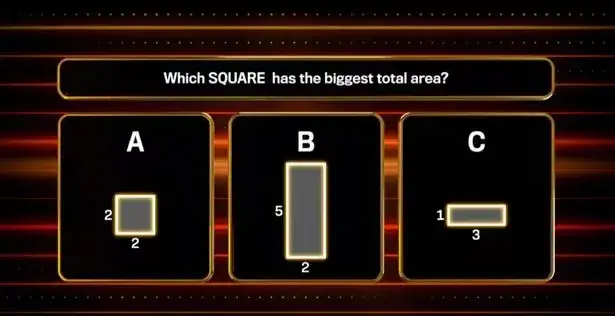
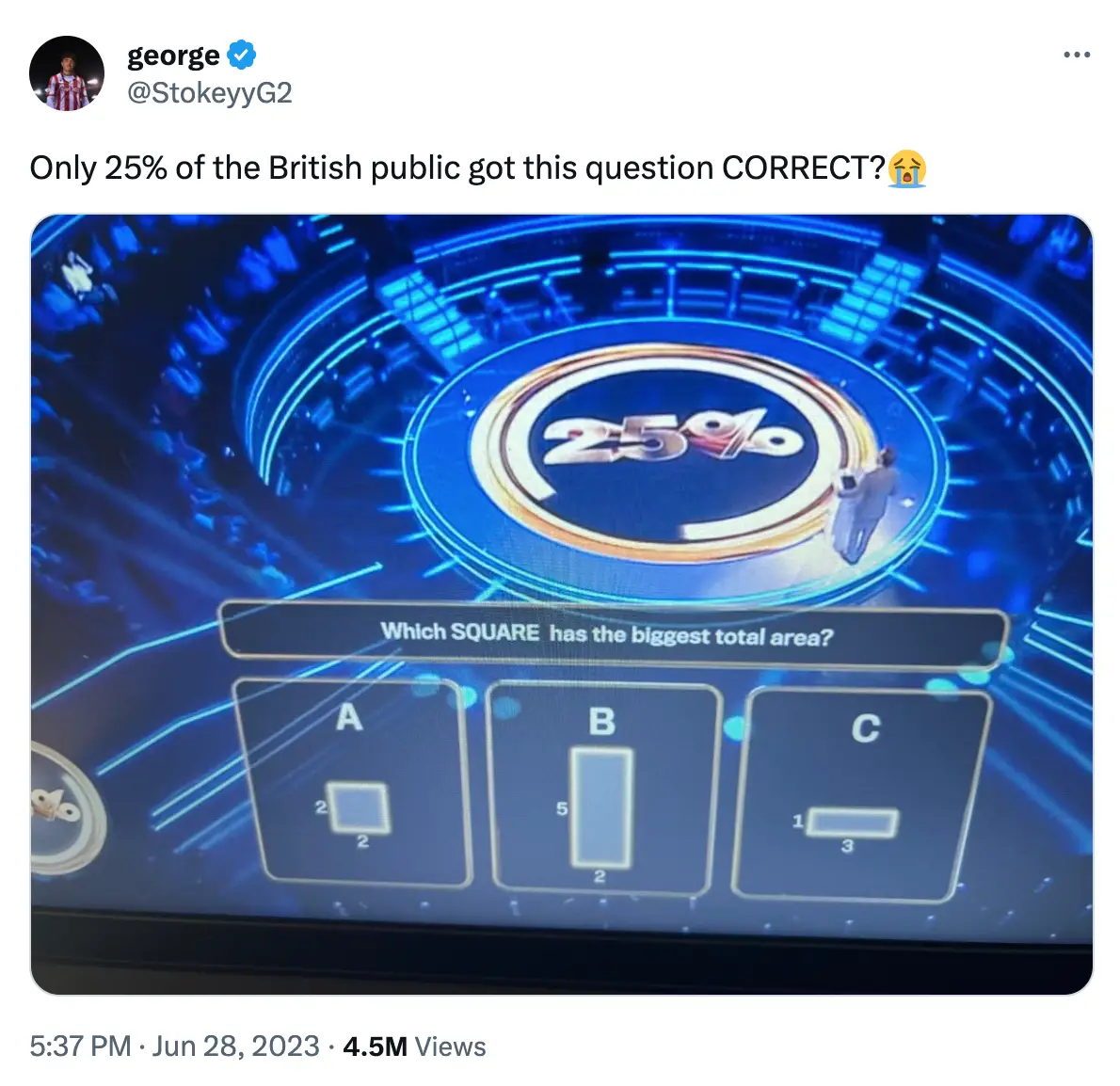
Contestants were shown three geometric shapes labelled A, B and C and asked:
“Which SQUARE has the biggest total area?”
At first glance, the question seemed to require some straightforward comparison of the three shapes. Yet only 25 percent of the contestants selected the correct option.
Digital creator George Stokey highlighted the result on Twitter, writing: “Only 25% of the British public got this question CORRECT?”
The post was accompanied by a sad-face emoji, reflecting just how surprising the result appeared.
For many viewers, however, the difficulty was not the shapes themselves — it was the wording of the question.
The clue was hiding in plain sight
The trick was contained in one particular word.
Although all three options were geometric shapes, only A was actually a square. The other two shapes, B and C, were rectangles.
That meant contestants did not need to calculate the areas of all three shapes. The question specifically asked which square had the biggest total area, making A the only possible answer.
One viewer explained the reasoning simply: “It is A because other options are Rectangles and the question is about a SQUARE.”
Another pointed out the defining property of a square: all four sides are equal, whereas B and C had only their opposite sides equal.
Viewers admit they were caught out too
The reaction online showed that contestants were not the only ones who initially missed the trick.
One viewer admitted they “went for B at first then read the question again,” while another said their first instinct was also wrong before they looked at the wording more carefully.
Others confessed that the puzzle had kept them thinking for the full 30 seconds.
“Nah they had me for about 30 seconds can’t even lie,” one viewer wrote.
Another admitted they would have chosen incorrectly without reading the comments.
The question may have looked simple once the wording was noticed, but the reaction demonstrated exactly what The 1% Club is designed to test: whether contestants can slow down, read carefully and avoid making assumptions under pressure.
In this case, the most important part of the puzzle was not hidden in the shapes at all — it was sitting in the question itself.