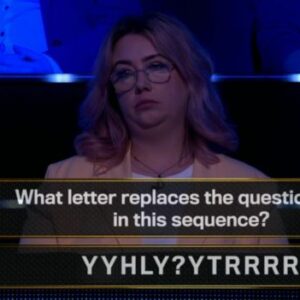
The 1% Club’s £96,000 Final Left Viewers Stunned By A Question About Counting Dots
Three contestants made it through to the final stage of The 1% Club, with £96,000 waiting to be won.
By that point, they were facing the question designed to be the toughest of the night — one that, according to the show’s format, only around one per cent of people would be expected to answer correctly.
Then the final puzzle appeared on screen.
Instead of a complicated sequence, tricky wordplay or obscure general knowledge, contestants were asked to do something that seemed almost laughably simple: count the dots.
Two players got it right and split the jackpot, taking home £48,000 each. But for viewers watching at home, the question quickly became a source of disbelief, with some calling it one of the easiest 1% questions they had seen.
Three Contestants Reached The Final
The 1% Club begins with 100 contestants and gradually eliminates players through a series of questions focused on logic and problem-solving rather than traditional general knowledge.
The difficulty increases throughout the programme before the remaining players face the notorious 1% question.
On this occasion, Courtney, Wayne and Sam were the three contestants who made it to the final, with a £96,000 prize pot at stake.
Host Lee Mack then presented them with the final challenge:
“How many dots (i.e. ‘.’) – including any used in punctuation and letters… – are used in writing this question?”
At first glance, the task appeared remarkably straightforward.
But reaching the final of The 1% Club can make even an apparently obvious question feel more complicated. With thousands of pounds depending on a single answer, contestants had to work out exactly what the question meant by “dots”.

The Answer Was Hidden In Plain Sight
The key was in the wording itself.
Contestants weren’t simply being asked to count the full stops. They had to include all the dots appearing in the question, including those that form part of letters and punctuation.
That meant looking carefully at the entire sentence rather than focusing only on the most obvious marks.
The dots above letters such as i had to be counted, as did the relevant dots incorporated into the punctuation displayed in the question.
There was no complicated mathematical formula or hidden sequence to uncover. The difficulty came from making sure that every single dot was accounted for.
The correct total was:
17.

Courtney Missed The Final Answer
All three contestants had the chance to solve the puzzle, but only two reached the correct total.
Courtney answered incorrectly, while Wayne and Sam both gave 17.
With two contestants getting the answer right, the £96,000 jackpot was divided equally, giving Wayne and Sam £48,000 each.
For the two winners, careful attention to a collection of tiny marks had turned into a very substantial payday.
But viewers at home had a rather different reaction.
Viewers Questioned The Difficulty
Many fans were surprised that a simple counting exercise had appeared as the show’s final 1% challenge.
Some viewers initially suspected there had to be another trick they had missed.
One wrote: “Embarrassing that counting dots was a 1% question.”
Another commented: “This was an easy 1% question to be fair.”
A third called it “the easiest 1% question ever.”
Another viewer said that everyone watching with them had reached 17 and was surprised by how uncomplicated the puzzle seemed.
“We all got 17 and couldn’t believe it was that easy, almost as if there has to be a catch here,” they wrote.
They added: “Literally just needed to count. The 1% is usually rock hard.”
Why Such A Simple Question Could Still Be Difficult
Once the answer is known, the puzzle seems almost too easy.
But that may also be what makes it effective.
By the time contestants reach the final, they’ve already faced a series of increasingly challenging logic questions. They know the 1% challenge is supposed to be the toughest one of the night.
Being suddenly asked to count dots can therefore create a different kind of pressure.
A contestant may begin wondering whether there is another layer to the question, whether certain marks should be excluded or whether they have misunderstood what counts as a dot.
All the while, the clock continues to run.
Rather than requiring an elaborate piece of deduction, the puzzle demands concentration and precision. The biggest obstacle can be resisting the instinct to look for a more complicated answer when the solution is actually sitting in front of you.

Missing One Dot Changes Everything
The phrase “including any used in punctuation and letters” is particularly important.
A dot above an i counts, while relevant dots contained within the punctuation also need to be included.
The example given in the question itself is part of what contestants have to examine.
That leaves very little room for error. Missing even one dot means arriving at the wrong total.
Unlike a traditional logic puzzle, there is no pattern to discover that can suddenly reveal the answer. The task is simply to identify every qualifying dot before time runs out.
Courtney missed the correct total.
Wayne and Sam found all 17.
That small difference was worth £48,000 each.
A £48,000 Payday From A Counting Exercise
The final result captures one of the unusual aspects of The 1% Club: a question doesn’t necessarily have to look complicated to create pressure.
For Wayne and Sam, the supposedly toughest question of the episode ultimately came down to careful observation.
There was no equation to solve, no specialist knowledge required and no elaborate deduction.
They simply had to count every qualifying dot in the sentence.
The answer was 17.
Two contestants found it. One didn’t.
And that was enough for Wayne and Sam to split the entire £96,000 prize pot, turning an apparently ordinary counting exercise into a £48,000 payday for each winner.