My sister appeared in the first photograph at 8:42 on the morning of my wedding.
She stood behind me in the bridal-suite mirror, wearing a pale green dress and the silver necklace she had been buried with seven years earlier.
Nobody noticed until midnight.
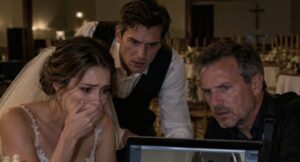
By then, the cake had been cut, the guests had left and my new husband Nathan was helping photographer Owen Price back up his files in the empty church hall. I sat beside them, barefoot and exhausted, expecting photographs of ordinary happiness.
Owen stopped scrolling.
“Who is that?”
Behind my reflection stood a young woman with dark hair falling over one shoulder. Her face was blurred, but I knew the small crescent-shaped scar above her eyebrow.
“Rebecca,” I said.
Nathan squeezed my hand. He had never met my sister, but he recognized her from the photograph on my dresser.
Rebecca died at twenty-four when her car left a mountain road during heavy rain. Police ruled it an accident. My father identified her body. The closed casket was buried with her favorite necklace because the crash had damaged its clasp.
Owen checked the image metadata. The photograph had not been altered. He showed us the next frame.
Rebecca stood closer.
She appeared again near the church steps, behind my bridesmaids, reflected in a catering tray and visible through the rear window of my father’s car. In every photograph, she wore the green dress I had secretly chosen for her years before I was engaged.
At 12:19, my father returned to the hall.
He said he had forgotten his speech notes. When he saw the laptop, he crossed the room and slammed it shut.
“Delete those.”
Owen pulled the computer away. “Sir, these are the wedding files.”
“They’re corrupted.”
My father had not yet seen the close-up. He should not have known what was on the screen.
Nathan asked how he knew.
Dad’s expression collapsed for half a second. Then he said I had always looked for signs from Rebecca and grief could turn shadows into faces.
Owen reopened the laptop. He enlarged a photograph taken in the sanctuary before anyone arrived. Rebecca appeared in the mirror behind the pulpit.
So did a man standing behind my father.
The man held Rebecca’s silver necklace.
Dad grabbed the laptop. Nathan stopped him. During the struggle, the old telephone in the church office began to ring.
That phone had no outside line. It connected only to the rectory, which had been empty since the pastor left after the reception.
I answered.
Rebecca’s voice said, “Emily, ask Dad who drove me home.”
The doors slammed shut.
My father locked them.
“Nobody leaves with those photographs,” he said.
Nathan stepped between us. Owen quietly copied the files to a memory card and slipped it into his sock.
Dad began crying. He said the images would destroy our mother, who had suffered heart problems since Rebecca’s death. He begged me to remember that families survive by refusing to reopen wounds.
“Who drove her home?” I asked.
He looked toward the mirror.
The second man was still visible on the laptop. I recognized him slowly: Charles Vane, Dad’s former business partner and my godfather.
Charles disappeared from our lives two months after Rebecca died. Dad said they fell out over money. The partnership dissolved, and Charles moved overseas.
Rebecca had worked as their bookkeeper.
On the night she died, she attended the company’s anniversary dinner. Dad told police she left alone at 10:30. Security footage from the restaurant had been unavailable because its system failed.
Owen searched the wedding images for Charles. The reflected figure appeared six times, always behind Dad, always holding the necklace.
In the final photograph, he pointed toward the church crypt.
St. Matthew’s had a small burial chamber beneath the sanctuary, sealed for renovations. Our father’s company had completed those renovations seven years earlier—the week after Rebecca’s funeral.
Dad stood in front of the basement stairs.
“There is nothing down there.”
Three knocks sounded from below.
Then Rebecca’s voice came through the office telephone again.
“He is not the one in my grave.”
Dad dropped the key ring.
I called police while Nathan unlocked the side door. My father did not run. He sat beneath the wedding flowers repeating that he had wanted to protect us.
Officers arrived within minutes. They initially believed we were dealing with an emotional family dispute. Then Owen showed them the photographs, and Dad admitted there might be “business records” in the crypt.
A search warrant followed before dawn.
Behind a recently replaced stone panel, investigators found Charles Vane’s remains wrapped in construction sheeting. His skull showed evidence of blunt-force trauma. Around his neck hung Rebecca’s silver necklace.
The person buried as Rebecca was not Charles. Dental records later identified her as Kara Bell, a young woman reported missing from a neighboring county two days before the crash.
Kara resembled Rebecca in height and hair color. Severe injuries and my father’s identification prevented immediate scrutiny. The medical examiner had relied on family confirmation and belongings found in the vehicle.
My sister had not died in that car.
Dad finally told the story.
Rebecca discovered that he and Charles were using company accounts to launder money for a property investor. She copied the records and threatened to report them. Charles, frightened, agreed to help her.
On the night of the anniversary dinner, Dad followed them to the church office, where Charles had hidden backup ledgers during renovation work. An argument became violent. Dad struck Charles with a stone sample and killed him.
Rebecca escaped.
Dad staged the mountain crash using Kara’s body, which an associate obtained through a chain of crimes he refused to describe. He expected Rebecca to return once she learned she was officially dead. She never did.
For seven years, he did not know whether his daughter was alive.
The photographs were not proof that Rebecca was dead. They were directions to the man who had tried to save her.
Inside the crypt, police found waterproof ledgers and a locker key taped beneath a beam. The key opened a train-station locker rented under Rebecca’s middle name. It contained copies of the financial records, letters to me and a prepaid phone sealed in its original box.
The letters ended three months after her supposed death.
In the final one, Rebecca wrote that she had seen Dad’s associate watching our house. She planned to leave the country until she could contact federal investigators safely. She begged me not to believe she abandoned us.
There was no proof she reached her destination.
My father was arrested for Charles’s murder, conspiracy, fraud and crimes connected to the staged crash. His testimony led police to the associate, who was serving time for an unrelated offense. That man admitted obtaining Kara’s body after she died during an assault committed by another participant. The details were worse than any ghost story.
Kara’s family had buried an empty coffin. We returned her remains and told them the truth my family’s lie had stolen.
My mother survived the shock. Her first response was anger at me for calling police on my wedding night. Then she read Rebecca’s letters and learned Dad had let her mourn a living daughter while never allowing investigators to search.
She removed her wedding ring.
“He did not protect me,” she said. “He protected the version of himself I loved.”
The wedding photographs spread among investigators but were never released publicly. Forensic analysts found no editing, compositing or double exposure. They explained some figures as reflections. They could not explain why Rebecca’s image appeared in photographs taken by three different cameras, including a disposable camera used by a child.
They also could not explain the church calls. The internal phone system had been disconnected for renovation two days before the wedding.
Six months later, an email arrived from an address using Rebecca’s childhood nickname. It contained one sentence: I saw the green dress.
Attached was a photograph of a coastal café. A woman sat with her back to the camera. The scar above her eyebrow was not visible, but Rebecca’s habit of twisting a paper napkin around her index finger was unmistakable.
Federal investigators traced the email through several countries and reached no conclusion.
My mother believed Rebecca was alive and hiding. Nathan believed someone connected to the case wanted to give us hope. I did not know which possibility frightened me more.
One year after the wedding, Owen asked permission to inspect the original files again. He had discovered that the images containing Rebecca formed a sequence when sorted by the direction of her gaze.
In each photograph, she looked toward a different letter carved into the church memorial wall.
Together, the letters spelled: NOT SAFE YET.
The second figure—Charles—pointed toward the crypt because his body and the evidence were there. Rebecca looked toward the warning because whoever helped stage the crash had not all been identified.
Police reopened the laundering investigation. Two additional arrests followed, including the property investor who had quietly attended my wedding as my father’s guest.
He appeared in several photographs.
In every one, Rebecca stood directly behind him.
He confessed after being shown the pictures. His attorney later said they had no evidentiary value, but the investor believed Rebecca was alive and knew where he lived. Fear accomplished what seven years of accounting subpoenas had not.
Our marriage began under police lights, so Nathan and I held a small second ceremony on our first anniversary. No ballroom, no elaborate dress, only our mothers, Kara’s parents and a few friends beside the sea.
At sunset, Owen took one photograph.
When he checked the screen, a woman in pale green stood at the edge of the water. This time her face was clear.
Rebecca was smiling.
I ran toward the shoreline. Nobody was there. The wet sand showed only my footprints.
In the photograph, Rebecca wore no necklace. Charles was gone.
On the back of Owen’s camera, the image displayed for seven seconds before the file corrupted. The backup contained only gray static. Owen had photographed the screen with his phone, preserving a lower-quality copy.
I keep that copy beside Rebecca’s letters.
People ask whether my sister was a ghost, a fugitive or both—alive somewhere while a part of her returned to finish what fear interrupted. I cannot answer.
I know my father buried one man, buried another woman under my sister’s name and expected grief to make us stop asking questions.
Instead, Rebecca came to my wedding dressed for the place she should have occupied.
She did not ruin the happiest day of my life.
She gave my family back the truth—and left one final mystery standing at the edge of the sea.
Three months after the second ceremony, Kara’s mother mailed me a package. Inside was the disposable camera used by the child at my wedding. Investigators had returned it after developing the film. One frame had never appeared in the digital evidence set.
It showed my father locking the church doors. Reflected in the glass beside him were Rebecca and Kara together. Rebecca wore green. Kara wore the silver necklace. Both women pointed toward the office telephone.
Kara had never entered St. Matthew’s while alive. Rebecca could not have known what she looked like; the identification photographs were sealed until after the wedding.
I showed the image to no analyst. Kara’s mother and I placed it between their two letters and agreed that some evidence answers a legal question while other evidence changes only the people who see it.
The following morning, my phone displayed a voicemail with no number and no timestamp. Two women were laughing beside the sound of waves. Then Rebecca said the phrase she used whenever we ended childhood games of hide-and-seek:
“You found enough for now.”
I saved the message in three places. By evening, all three copies had become seven seconds of gray static.
The photograph did not change.
Sometimes I study the space behind the two sisters, wondering whether it shows a real coastline or another reflection. Far in the distance stands a third figure whose face cannot be seen.
The mystery is no longer whether the dead appeared at my wedding.
It is whether Rebecca was ever among them.