Seven hours is a long time for television. It is roughly the length of a working day, a full night’s sleep, or the drive from Melbourne to Canberra.
It is also the running time of Banished, Jimmy McGovern’s seven-part BBC drama about the establishment of the British penal colony in New South Wales following the arrival of the First Fleet in 1788. The series has plenty of room to explore the brutal realities facing the convicts, soldiers and officials who found themselves in an unfamiliar and unforgiving environment.
But there is one enormous problem with the story it chooses to tell: the Indigenous people whose land the colony was established upon are almost entirely absent from it.
That omission is difficult to overlook, particularly in a drama set during the earliest days of British colonisation in Australia.
The people who are there — but never seen
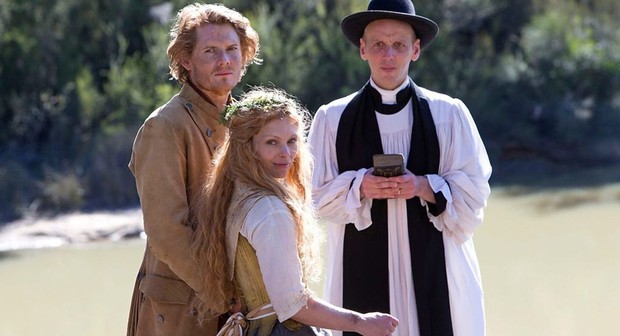
The Aboriginal people are occasionally mentioned throughout Banished, but largely as an unseen presence.
Characters speculate about the “natives”, make assumptions about what they might be like and refer to possible encounters. One convict even imagines escaping into the bush and seeking their protection.
There are also references to Aboriginal spears and to the destruction of the colony’s fishing nets, with one character suggesting that the Indigenous people may believe the settlers are taking too many fish.
But those references never develop into a meaningful Indigenous presence on screen.
There is no Aboriginal character with a substantial role, no Indigenous perspective and no sustained encounter between the newcomers and the people already living on the land.
Instead, the natural environment becomes the principal visual reminder of Australia. Kangaroos, snakes and birds appear, while the people themselves remain conspicuously outside the frame.
That is a serious weakness for a drama dealing with the arrival of the First Fleet and the beginnings of British settlement.
McGovern’s explanation

The omission was particularly controversial because Banished was created by Jimmy McGovern, who had previously worked on the Australian Indigenous-themed series Redfern Now.
McGovern defended the decision by explaining that the series was designed around the British experience of the settlement. He had also considered a second series that would have explored the Aboriginal experience through Indigenous characters, actors and writers, but that follow-up did not materialise.
His argument was that properly telling the Indigenous story would require sufficient time and the involvement of Indigenous writers and performers rather than simply inserting Aboriginal characters into the background.
Australian actor Ryan Corr, who plays Private McDonald, also acknowledged that the absence of Indigenous characters had been discussed during production. Corr said McGovern felt seven one-hour episodes were not enough time to tell that story properly.
The reasoning may explain the creative choice, but it does not necessarily solve the historical problem.
A British story set on Australian soil

The central criticism is straightforward: the events of 1788 cannot be separated neatly into a “British story” and an “Indigenous story”.
The arrival of the First Fleet took place on land already occupied by Aboriginal peoples. The beginning of the penal colony therefore involved not only the hardships experienced by British convicts and soldiers, but also the arrival of a foreign power, the seizure of land and resources, and the increasingly difficult relationship between settlers and Indigenous communities.
That history extends far beyond the seven hours covered by Banished. But the decision to largely remove Indigenous people from the story creates the impression that the British settlement existed in isolation.
Contemporary Australian critics argued that the absence risked reinforcing the old idea of Australia as effectively empty land — the concept commonly associated with terra nullius.
That is why the omission feels more significant than an ordinary casting or storytelling decision.
Where the drama succeeds
There is, however, plenty to admire in Banished.
The series focuses on the convicts, soldiers and officials struggling to survive during the colony’s earliest weeks. Food is scarce, discipline is harsh and the threat of punishment hangs over the settlement.
The BBC itself described the drama as a story of survival centred on love, faith, justice and morality within a confined community where the consequences of every decision can be severe.
That gives McGovern plenty of material to work with.
Relationships develop under extraordinary pressure, while questions surrounding food, punishment, sex, marriage and authority become matters of life and death.
The series is deliberately far removed from the polished image of traditional British period drama. Its world is physical, dirty and uncomfortable, with hunger and violence constantly pressing against the characters.
The result is a drama that can be grim, but also surprisingly lively and occasionally funny. Earlier reviews praised its unusual combination of hardship, romance, sexuality and dark humor.
A strong ensemble cast
The cast is another major asset.
MyAnna Buring, Julian Rhind-Tutt, Genevieve O’Reilly, David Dawson, Rory McCann, Russell Tovey, David Wenham and Ryan Corr all contribute to the sprawling ensemble.
Russell Tovey plays James Freeman, a convict struggling with hunger and the brutal realities of colonial life.
MyAnna Buring plays Elizabeth Quinn, whose relationship with Tommy Barrett, played by Julian Rhind-Tutt, becomes one of the drama’s central romantic storylines.
David Wenham takes on the role of Captain Arthur Phillip, the first governor of New South Wales.
Phillip gives the series perhaps its most interesting opportunity to explore the moral contradictions of early colonial government.
Arthur Phillip’s impossible choices
Wenham’s Phillip is portrayed as an idealistic administrator attempting to impose some form of order on a settlement facing extraordinary shortages and instability.
He must decide how food should be distributed when supplies are running low. He must determine which offenses deserve severe punishment and whether convicts should be allowed to marry despite the circumstances that brought them to the colony.
The drama uses these dilemmas to explore the nature of authority in a penal settlement where more than 1,000 prisoners were guarded by roughly 100 marines.
But this is also where the absence of Indigenous characters becomes particularly frustrating.
Historically, Phillip’s relationship with the Indigenous custodians of Port Jackson was an important part of his experience as governor. His interactions with Bennelong, as well as his orders concerning the treatment of the local Aboriginal population, form an important part of the historical context surrounding the settlement.
Yet none of that appears in Banished.
A missed opportunity
The series is perfectly entitled to focus on the convict experience. Their survival, relationships and struggles provide enough material for a compelling drama.
But that focus does not have to mean completely removing the people whose land they have entered.
The Indigenous population was not merely an additional storyline that could be introduced if the writers had enough time. Their presence was part of the fundamental reality of the colony from the beginning.
Even a limited exploration of those encounters could have given the series a far richer understanding of the world it depicts.
Instead, Banished largely becomes a story about British convicts surviving hardship in a strange landscape, rather than a story about what happened when British colonisation entered an already inhabited country.
Verdict
Banished has many of the ingredients of an absorbing historical drama: a strong cast, harsh conditions, complicated relationships, moral dilemmas and a setting filled with dramatic possibilities.
Its portrayal of convict life is compelling, and the performances help give the settlement a sense of desperation and unpredictability.
But the decision to leave Indigenous Australians almost entirely outside the story is a fundamental weakness.
For a seven-part drama about the arrival of the First Fleet in 1788, that absence is impossible to treat as a minor detail. The result is an entertaining and often gripping piece of television that nevertheless feels incomplete precisely where its historical subject matter demands the greatest care.
There is more than enough drama in Banished to fill seven hours. The problem is whose story those seven hours ultimately choose to tell.