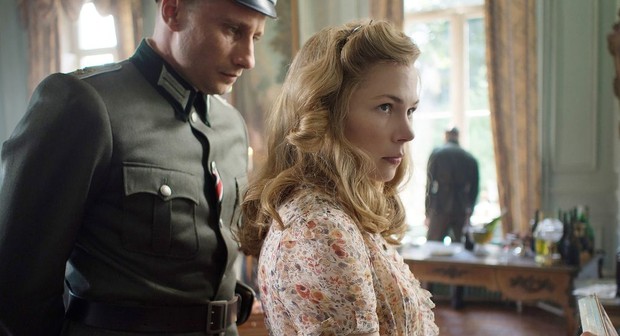
Set in German-occupied France during World War II, Suite Française builds its drama around an impossible relationship: a lonely Frenchwoman and the cultured German officer billeted in her home. It is a familiar wartime premise, but the film gives it an appealing combination of romance, tension, period detail and strong performances.
Directed by Saul Dibb and starring Michelle Williams, Matthias Schoenaerts and Kristin Scott Thomas, the 2014 film adapts Irène Némirovsky’s unfinished novel, a remarkable work that was written during the war and only discovered decades after the author’s death. Critics were divided over the adaptation, particularly its narration and occasional melodramatic choices, but many praised its performances, cinematography and thoughtful depiction of life under occupation.
A Story Written in the Shadow of War
The history behind Suite Française is almost as remarkable as the story itself.
Irène Némirovsky began writing the work while Europe was being transformed by war. A Ukrainian-born Jewish writer who had settled in France, she was arrested and deported to Auschwitz, where she died in 1942 at the age of 39.
Her daughters preserved her notebooks without initially realizing what they contained. It was only decades later that her daughter Denise discovered that the manuscripts were not diaries but an unfinished literary project.
The planned work was to consist of five parts, but only two were completed. Those sections were eventually published together as Suite Française in 2004, becoming a major literary success.
That unusual origin gives the story a distinctive quality. Although fictional, it carries the immediacy of writing produced during the events it describes.
For the film adaptation, Dibb and co-writer Matt Charman largely concentrate on the second section, Dolce, while incorporating elements from the opening section, Storm in June, to create a more complete cinematic narrative.
A French Village Under Occupation

The movie begins in 1940 as the German advance forces people from their homes.
After a brief depiction of the Allied evacuation at Dunkirk, the story moves to the rural French village of Bussy.
Life there is suddenly transformed.
German soldiers arrive and are assigned rooms in local homes. The villagers must live alongside the occupying forces, while class divisions, resentment and fear simmer beneath the surface.
At the center of this world is Lucile Angellier, played by Michelle Williams.
Lucile lives with her formidable mother-in-law, Madame Angellier, portrayed by Kristin Scott Thomas. Her husband is away fighting, leaving Lucile trapped in an unhappy marriage and an emotionally restrictive household.
Madame Angellier is wealthy, proud and fiercely controlling. Her relationship with Lucile is already strained, while the local farmers have their own reasons for resenting her.
The German occupation does not erase those tensions.
Instead, it exposes them.
As Time Out noted, one of the film’s more interesting qualities is its portrait of a class-conscious rural society in which occupation forces questions of collaboration, compassion and betrayal into the open.
Then Bruno Arrives

Everything becomes more complicated when a German officer is billeted in the Angellier household.
Lieutenant Bruno von Falk, played by Matthias Schoenaerts, is hardly the stereotypical Nazi villain.
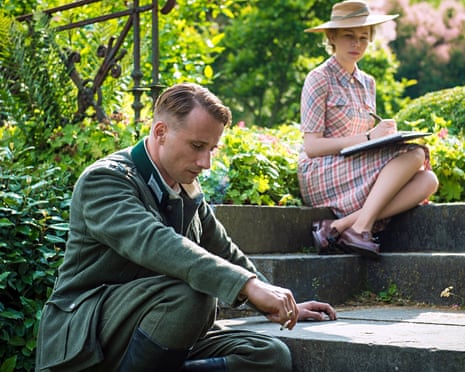
He is courteous, cultured and deeply interested in music. He plays the piano in the house and is composing a piece of his own.
That does not erase the fact that he is an officer of the occupying German army.
But for Lucile, who has been living in emotional isolation, his presence creates an unexpected connection.
Their relationship begins quietly.
There is no immediate declaration of love. Instead, they observe one another, discover a shared appreciation for music and gradually become aware of an attraction that neither can safely acknowledge.
The music Bruno is composing becomes an important thread connecting them.
It also gives the romance a sense of intimacy that exists largely outside spoken dialogue.
And that is where the film is at its strongest.
Love Becomes a Dangerous Secret
Lucile and Bruno know that their feelings cannot simply be acted upon.
They are on opposite sides of an occupation that has divided the country.
Their growing closeness therefore becomes dangerous not only because of what it means personally, but because of what others might think.
Suspicion begins to spread.
Meanwhile, another storyline brings the brutal realities of occupation into sharper focus.
A struggling farming couple, Benoît and Madeleine, played by Sam Riley and Ruth Wilson, are dealing with a Nazi soldier whose behavior toward them becomes increasingly threatening.
Their situation eventually brings them into contact with Lucile and Bruno, intertwining the romantic story with the broader question of how ordinary French people survive under German control.
The film consequently becomes more than a forbidden romance.
It examines how war changes relationships between neighbors, families, landlords, farmers and occupiers — and how quickly ordinary social divisions can become matters of survival.
The Romance Has Its Limits
The central relationship between Lucile and Bruno is deliberately restrained, but that restraint also became one of the film’s most debated elements.
Michelle Williams plays Lucile with quiet intelligence and emotional reserve. Rather than turning her into an openly passionate heroine, she allows much of the character’s conflict to appear through expression and body language.
Matthias Schoenaerts provides a strong counterpart as Bruno, giving the German officer an elegant exterior while suggesting the contradictions beneath it.
Several critics praised the chemistry between the two actors. CineVue, for example, highlighted the simmering connection between Williams and Schoenaerts, while Time Out described the film as thoughtful despite its imperfections.
Other critics felt the romance was less convincing.
The Guardian argued that the film’s central love story was actually less interesting than its wider portrait of occupied French society, while criticizing the character of Lucile as underwritten and the voiceover as unnecessary.
That criticism points to one of the film’s clearest weaknesses.
When the Voiceover Says Too Much

The filmmakers faced a difficult task in adapting Némirovsky’s unfinished material.
Rather than leaving the emotions largely unspoken, the film sometimes explains what the audience can already see.
Lucile’s first-person narration repeatedly tells viewers what she is feeling, even though Williams is capable of communicating much of that emotion without words.
That choice works against the film’s most effective quality: its silences.
The relationship between Lucile and Bruno is interesting precisely because they cannot freely express what is happening between them.
Their glances, pauses and shared moments around the piano often say more than the narration.
The result is an odd contradiction: the film understands the power of restrained emotion, yet occasionally feels compelled to explain it.
A Classic Wartime Drama With a Modern Gloss
Visually, Suite Française is one of its era’s more polished period productions.
Cinematographer Eduard Grau, known for A Single Man, photographs the French countryside and village interiors with considerable elegance. The film was shot on 35mm and used Belgian locations to recreate the atmosphere of occupied France.
The costumes are equally important.
Michael O’Connor, who previously worked with Dibb on The Duchess, creates clothing that helps establish both social class and character. Hair and makeup designer Jenny Shircore contributes to the film’s carefully constructed period appearance.
The overall effect is undeniably beautiful.
That beauty, however, can sometimes work against the darker realities of the story.
Some critics felt that the film’s polished appearance softened material that should have felt harsher. Others appreciated the craftsmanship and considered the visual richness part of its appeal. Screen Daily specifically praised the film’s glossy design, staging and costumes, as well as Williams’ performance.
Music as the Film’s Emotional Language
Music plays a particularly important role.
Bruno is not simply a German officer with an interest in music; his composition becomes a means of communicating feelings that he and Lucile cannot openly express.
The film’s score was composed by Rael Jones, while Alexandre Desplat contributed the musical piece associated with Bruno’s character.
That composition becomes one of the film’s most memorable details because it functions as both a plot device and an emotional bridge between two people who are separated by circumstance, nationality and war.
In a story built around things left unsaid, music becomes another language.
The War Is Bigger Than the Romance
One of the most compelling aspects of Suite Française is that the occupation gradually exposes the complicated behavior of the people living through it.
Not everyone responds to the German presence in the same way.
Some collaborate.
Some resist.
Some attempt to survive without taking sides.
Others discover that their personal loyalties do not fit neatly into political categories.
That complexity is one reason several critics found the film more interesting when it moved beyond the central romance. The Guardian noted that the wider social and political tensions of the village could be more compelling than the love story itself, while Time Out praised the film’s attention to collaboration, compassion and betrayal.
The story asks uncomfortable questions without always providing simple answers.
What does loyalty mean during an occupation?
Can compassion exist between enemies?
And what happens when private feelings collide with public allegiance?
A Handsome, Imperfect Adaptation
Suite Française ultimately works best as a carefully mounted period drama rather than as a definitive wartime romance.
Its screenplay has weaknesses. The voiceover can be heavy-handed, some plot developments feel overly convenient, and the film occasionally pushes its drama further than the source material requires.
Yet its strengths are substantial.
The performances are committed. The production design is elegant. The cinematography gives the story a tangible sense of place. And the combination of romance and occupation creates a naturally compelling tension.
The film received a generally favorable critical response overall, with a 63 Metascore based on nine critics at Metacritic; Rotten Tomatoes lists a 75% Tomatometer score from 44 reviews.
More importantly, the film preserves something essential from Némirovsky’s story: the unsettling ambiguity of ordinary people attempting to live normal lives while history is collapsing around them.
Suite Française may not completely capture the subtlety of the unfinished novel that inspired it.
But when it stops explaining itself and simply allows its characters to look, hesitate, listen and make impossible choices, the film finds a quiet emotional power of its own.
It is a wartime romance, certainly.
But beneath the romance is a portrait of a society forced to discover what its people are really made of when the familiar world disappears.