Part 2: The Dress Was Never the Secret—It Was the Truth Hidden Beneath It
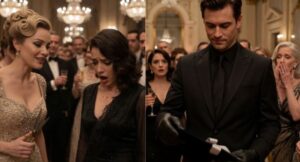
No one breathed.
The ballroom fell so silent that the soft rustle of paper sounded louder than the orchestra.
The man carefully unfolded the second document from the velvet folder.
His expression changed.
Not with surprise.
With recognition.
He slowly looked at Maren before turning toward the two museum trustees standing near the front.
“I believe both of you should see this.”
They approached almost reluctantly.
One of them adjusted his glasses.
The other covered her mouth before the page was even fully opened.
“Oh… my God.”
Across the room, Victoria’s mother staggered backward until she collided with a marble column.
Victoria’s face had gone completely white.
“No,” she whispered.
“Don’t read it.”
The man ignored her.
Instead, he addressed the guests.
“Many of you know the story of The Autumn Bride.”
Heads nodded throughout the ballroom.
It was one of the most famous missing American paintings of the twentieth century—a masterpiece that had disappeared after a suspicious warehouse fire nearly sixty years earlier.
Insurance investigators called it destroyed.
Art historians called it lost forever.
Collectors spent decades searching for it.
The man lifted the faded photograph.
“This picture was taken two weeks before that fire.”
Everyone leaned closer.
In the photograph, a young woman stood smiling beside the painting.
Maren recognized her immediately.
Her grandmother.
Standing beside her was another familiar face.
Edward Langford.
Victoria’s grandfather.
The founder of the Langford Museum Foundation.
The man continued.
“History remembers Edward Langford as the man who tried to save this painting.”
He paused.
“But history was written by the wrong family.”
…
Victoria suddenly stepped forward.
“That photograph proves nothing.”
“No,” the man agreed calmly.
“It doesn’t.”
He looked toward Maren.
“The dress does.”
Every eye turned toward the silver lining exposed by the torn seam.
The tiny embroidered letters shimmered beneath the ballroom lights.
One museum trustee carefully knelt beside Maren.
“May I?”
She nodded.
The trustee gently lifted the torn edge of the fabric.
His hands began trembling.
“This isn’t decorative stitching.”
“No.”
“It’s handwriting.”
The silver thread formed thousands upon thousands of microscopic words.
Not patterns.
Not initials.
A complete written record.
Line after line.
Date after date.
Inventory numbers.
Painting dimensions.
Storage locations.
Transfer records.
Names.
Signatures.
Everything had been stitched by hand.
Victoria stared in horror.
“What is it?”
The elderly trustee slowly stood.
“It’s the catalogue.”
“What catalogue?”
“The original collection catalogue.”
A wave of confusion swept through the ballroom.
The trustee continued.
“When the warehouse burned, every inventory record disappeared.”
He looked back at the dress.
“We always believed they were destroyed.”
“They weren’t.”
He gently touched the silver embroidery.
“Someone rewrote every page…”
“…using needle and thread.”
…
Maren’s knees nearly gave way.
“My grandmother did this?”
The man holding the folder smiled softly.
“For six years.”
He opened another envelope.
Inside were dozens of old letters.
“She believed the written records would eventually disappear.”
“So she created another archive.”
“One nobody would think to steal.”
“The lining of a dress.”
Guests looked at the simple black gown with entirely different eyes now.
It had never been ordinary.
It had been a vault.
…
Victoria’s voice cracked.
“This proves nothing.”
The man calmly removed another photograph.
It showed Maren’s grandmother seated beside a sewing machine.
The silver lining stretched across her lap.
Beside her sat an unfinished painting.
On the back was a handwritten note.
If they erase my name…
…they will never erase the truth.
Signed,
Eleanor Ashcroft.
Maren’s grandmother.
…
One trustee carefully compared the embroidered inventory numbers to digital records on his tablet.
His breathing became uneven.
“They match.”
Another comparison.
“They all match.”
A third.
“So do the conservation notes.”
He looked up.
“No one could have fabricated this.”
These details had never been published.
Only the original registrar would have known them.
…
Victoria suddenly grabbed the scissors from the floor.
“You can’t use that dress!”
She lunged toward Maren.
Before she reached her, security stepped between them.
The scissors fell once again, sliding across the marble floor.
Victoria screamed.
“You don’t understand!”
“No,” one trustee replied quietly.
“We finally do.”
…
The man opened the final envelope.
Inside rested a single contract.
Unlike the others…
This one carried two signatures.
Edward Langford.
And Eleanor Ashcroft.
The room became silent again.
Edward had signed away full ownership of the collection to Eleanor after discovering widespread insurance fraud inside the foundation.
But the transfer had never been registered.
Three days later…
The warehouse burned.
Edward publicly claimed every document had been destroyed.
Then he quietly removed Eleanor’s name from museum history.
Everything built afterward…
The Langford Foundation.
Its reputation.
Its fortune.
Its influence.
Had rested on one enormous lie.
…
Victoria looked toward her mother.
“You knew?”
Her mother couldn’t answer.
Tears streamed silently down her face.
Finally she whispered,
“My father told us never to ask.”
Victoria stared at her in disbelief.
“You knew…”
“…all these years?”
“I knew enough to stay quiet.”
The confession echoed through the ballroom.
Several journalists immediately lowered their cameras.
Not because the story was over.
Because it had become far bigger than anyone imagined.
…
The museum trustees conferred quietly for several minutes.
Then the chairman turned toward the guests.
“As of this evening…”
“…the Langford Foundation’s claim to the Ashcroft Collection is formally disputed.”
Another trustee continued.
“We will immediately suspend all pending acquisitions and begin an independent forensic review.”
A third added,
“Every work connected to the original collection will be re-examined.”
Gasps filled the room.
Collectors looked at one another.
Some had paid tens of millions of dollars for paintings carrying the Langford provenance.
Everything was suddenly uncertain.
…
Victoria slowly sank into a chair.
She no longer looked angry.
Only defeated.
“It was supposed to be one little humiliation,” she whispered.
“I just wanted everyone to laugh at her.”
Maren looked down at the torn dress.
“My grandmother once told me something.”
Victoria looked up.
“Cruel people always believe they’re cutting someone else’s future.”
She gently touched the silver embroidery.
“They rarely realize…”
“…they’re cutting open their own secrets.”
…
Months later, conservators spent nearly four hundred hours documenting every line of silver stitching hidden inside the gown.
The embroidery proved so historically significant that it became one of the most important archival discoveries in modern American art history.
The black outer fabric was never repaired.
The tear remained exactly as Victoria had made it.
Not as damage.
As evidence.
…
A year later, a new exhibition opened at the National Museum of American Art.
The centerpiece wasn’t the missing masterpiece.
It wasn’t the contracts.
It wasn’t the photographs.
It was a simple black evening gown displayed inside a climate-controlled glass case.
The small plaque beneath it read:
“Truth is fragile.
Sometimes it survives not because it was protected…
…but because someone was brave enough to stitch it where no one thought to look.”
Every visitor stopped to read it.
Most arrived expecting to admire a famous painting.
Instead…
They left remembering the woman whose greatest masterpiece had never hung on a wall.
It had been quietly sewn into a dress…
…waiting decades for someone cruel enough to tear it open.