Netflix’s New Pride and Prejudice Looked Unnecessary — Until Its First Glimpse Revealed What Modern Romance Is Missing

Another adaptation of Pride and Prejudice initially sounded like a difficult proposition to defend.
Jane Austen’s novel has been revisited so many times that Netflix’s decision to turn it into a new six-part limited series immediately invited comparisons with two versions that continue to dominate the conversation: the BBC’s beloved 1995 adaptation starring Jennifer Ehle and Colin Firth, and Joe Wright’s visually sumptuous 2005 film with Keira Knightley and Matthew Macfadyen.
Netflix also had another obstacle to overcome.
Its 2022 adaptation of Persuasion, starring Dakota Johnson, divided Austen admirers with a knowingly modern tone that included fourth-wall breaking and contemporary dialogue. For viewers who prefer their Austen adaptations closer to the spirit of the novels, the prospect of Netflix returning to another of the author’s most cherished works was understandably met with caution.
Yet the first look at the new Pride and Prejudice suggests there may be a compelling reason to tell Elizabeth Bennet and Mr. Darcy’s story again.
It has something modern romance increasingly seems desperate for: yearning.
Emma Corrin and Jack Lowden Bring the Slow Burn Back

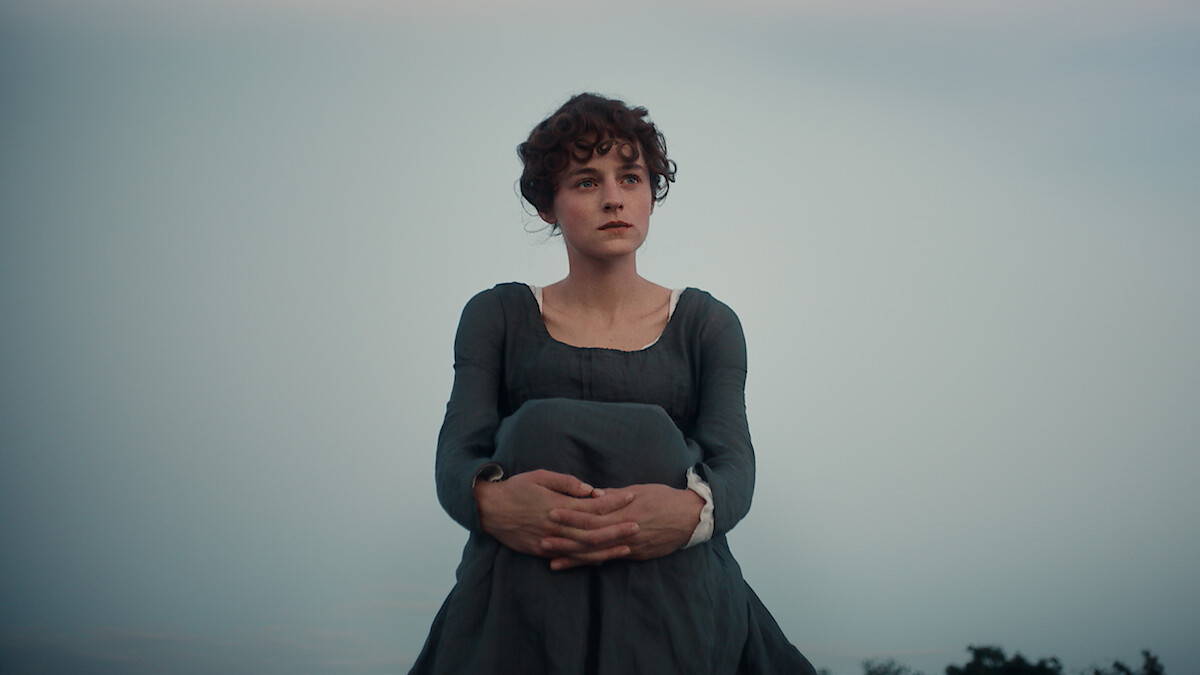
Netflix’s adaptation stars Emma Corrin as Elizabeth Bennet and Slow Horses actor Jack Lowden as Fitzwilliam Darcy.
The teaser does not attempt to reinvent their relationship with a radical new premise. Instead, it leans into the very thing that has kept Austen’s romance alive for more than two centuries: restraint.
There are glances that last a fraction too long. Characters observe each other from across rooms. Attraction is hidden beneath irritation, pride and social convention.
Netflix itself has emphasized that quality in its promotion of the series, inviting audiences to “yearn” for Corrin and Lowden as Elizabeth and Darcy. The platform describes the production as a “faithful, classic adaptation” of Austen’s novel rather than a contemporary reworking.
That distinction could prove crucial.
Part of what makes Pride and Prejudice so enduring is that Elizabeth and Darcy cannot simply state what they want the moment they feel it.
Their romance requires misunderstanding, embarrassment, personal growth and prolonged uncertainty.
In an entertainment landscape crowded with relationships that accelerate almost immediately, that kind of emotional restraint can suddenly feel surprisingly fresh.
Modern Dating May Be Exactly Why Austen Still Works
The mechanics of romance have changed almost beyond recognition since Austen published Pride and Prejudice in 1813.
Dating apps can offer another potential match in seconds. Social media encourages immediate access to people’s lives. Relationships can begin, intensify and disappear with extraordinary speed.
Against that background, stories built around waiting have gained a new kind of appeal.
The pleasure comes from what characters cannot say.
A look becomes important because nobody can send a late-night message explaining it five minutes later. A dance matters because physical proximity is limited. A misunderstanding can last because there is no instant method of clarification.
That emotional architecture is already built into Austen’s novel.
Rather than making Pride and Prejudice obsolete, modern dating culture may actually make its particular style of romance feel more desirable.
Elizabeth and Darcy do not fall in love because they immediately recognize each other as ideal partners. Quite the opposite.
They initially misunderstand, judge and dislike one another.
Their attraction develops only after both are forced to reconsider their assumptions.
That makes their eventual relationship satisfying not simply because two attractive characters finally get together, but because the romance depends on emotional change.
Television Has Already Rediscovered the Power of Yearning
Netflix’s timing is not accidental.
Recent romantic dramas have repeatedly demonstrated that audiences are willing to spend hours watching characters almost get together.
Bridgerton has built much of its success around precisely that tension.
The series turns Regency-era courtship into heightened romantic spectacle, but beneath the lavish costumes and orchestral pop covers is a remarkably traditional structure: characters stare, hesitate, misunderstand one another and spend extended stretches denying feelings that are obvious to everyone watching.
That formula remains powerful because anticipation is often more emotionally satisfying than immediate gratification.
The latest season continued that tradition through Benedict Bridgerton and Sophie Baek, played by Luke Thompson and Yerin Ha. Their socially complicated relationship is filled with stolen encounters and barriers that prevent their feelings from developing straightforwardly.
For viewers who responded to that slow-burn dynamic, Austen offers the original blueprint.
The Other Bennet Sister Proved There Is Still Room for More Austen
There is another reason not to dismiss Netflix’s new series simply because Pride and Prejudice has already received celebrated adaptations.
The BBC’s The Other Bennet Sister demonstrated how familiar Austen territory can still produce something emotionally different.
Based on Janice Hadlow’s novel, the drama shifts attention toward Mary Bennet, traditionally the awkward and frequently mocked Bennet sister.
Played by Ella Bruccoleri, Mary was given an interior life largely absent from most adaptations of Austen’s original novel.
Her relationship with lawyer Tom Hayward, played by Dónal Finn, introduced another romance built on misunderstandings, restraint and gradual connection.
Even Mr. Collins, one of Austen’s most reliably comic characters, received a more sympathetic interpretation through Ryan Sampson’s performance.
The success of that approach is important because it shows that familiarity does not necessarily eliminate possibility.
Characters audiences believe they already understand can look different when a new adaptation changes the emphasis.
A Christmas special for The Other Bennet Sister further reflects the appetite for this corner of Austen’s world.
Netflix Has Six Episodes to Find Something New
The format may be one of the strongest arguments in favor of Netflix returning to the novel.
The new Pride and Prejudice is a six-part limited series written by Dolly Alderton and directed by Euros Lyn, whose credits include Heartstopper. Netflix has confirmed that it is intended as a faithful adaptation.
That runtime gives the production something Joe Wright’s 2005 film could never fully possess: space.
The 2005 version remains admired for its visual romanticism, particularly the mist-covered landscapes, candlelit interiors and intense chemistry between Knightley and Macfadyen.
But compressing Austen’s novel into a feature-length movie inevitably means losing material.
The BBC’s 1995 series had the opposite advantage.
Across six episodes, Andrew Davies’ adaptation had time for the novel’s social detail, supporting characters and gradual transformation of Elizabeth and Darcy’s relationship.
Netflix now has the opportunity to combine those strengths.
If its teaser is representative of the finished production, the new series appears visually interested in sensuality and atmosphere while retaining television’s ability to let Austen’s story unfold slowly.
That combination may be its strongest justification for existing.
The Cast Extends Far Beyond Elizabeth and Darcy
Corrin and Lowden will naturally attract most of the attention, but Netflix has assembled a substantial ensemble around them.
Olivia Colman plays Mrs. Bennet, while Rufus Sewell appears as Mr. Bennet.
The supporting cast also includes Freya Mavor, Jamie Demetriou, Daryl McCormack, Rhea Norwood, Siena Kelly and Louis Partridge.
That matters because Pride and Prejudice has never been solely a love story.
The Bennet household, the pressures of inheritance, the danger of economically advantageous marriages and the social hierarchy surrounding the family are fundamental to Austen’s novel.
Mrs. Bennet’s obsession with finding husbands for her daughters can be played entirely for comedy, but underneath it lies a genuine financial anxiety: without a male heir, the Bennet daughters face considerable uncertainty.
A longer television adaptation has room to preserve that tension rather than reducing the story to Elizabeth waiting for Darcy.
Romance Is Only Half of What Makes Darcy Work
The modern fascination with Mr. Darcy sometimes reduces him to a fantasy of the distant, brooding romantic hero.
Austen’s version is more complicated.
Darcy is initially arrogant. Elizabeth is initially prejudiced against him. Both have enough evidence to believe their judgments are justified.
The love story only works because neither character is rewarded for remaining exactly the same.
Darcy must confront the way his behavior appears to others.
Elizabeth must recognize that her confidence in her own judgment has sometimes become another form of pride.
That mutual transformation is one reason the story has survived countless reinterpretations.
The yearning works because it exists alongside character development.
Without that, Darcy is simply a handsome man staring across rooms.
Netflix’s promise of a faithful adaptation suggests the series understands that distinction.
Even Contemporary Romance Is Looking Backward
The appetite for prolonged longing is not restricted to period drama.
The third season of The Summer I Turned Pretty similarly built much of its emotional momentum around Conrad Fisher, played by Christopher Briney, and his unresolved feelings for Belly Conklin, played by Lola Tung.
The setting could hardly be further removed from Austen’s England, but the mechanics are surprisingly familiar.
One character wants another person but cannot simply resolve the relationship.
Distance creates tension.
Silence becomes meaningful.
Audiences remain invested because the romance is postponed rather than immediately delivered.
It is difficult to ignore how often successful romantic storytelling is currently returning to those dynamics.
Lost in Austen Understood the Darcy Fantasy Years Ago
ITV’s 2008 miniseries Lost in Austen approached the phenomenon much more playfully.
Its heroine, Amanda Price, played by Jemima Rooper, is a modern woman obsessed with Pride and Prejudice who unexpectedly finds herself transported into Austen’s fictional world through a doorway in her bathroom.
The premise is comic, but its underlying idea now looks rather perceptive.
Amanda is dissatisfied not merely because she loves old novels, but because the kind of romance represented by Darcy feels absent from her contemporary life.
Nearly two decades later, that fantasy remains remarkably resilient.
For every attempt to modernize romantic storytelling, audiences continue returning to stories in which attraction requires patience.
Austen Is Having Another Major Screen Moment
Netflix’s Pride and Prejudice is also arriving amid a wider revival of Austen adaptations.
A new film version of Sense and Sensibility reaches UK cinemas on September 25, 2026.
Directed by Georgia Oakley and written by Diana Reid, it stars Daisy Edgar-Jones and Esmé Creed-Miles as the Dashwood sisters, with Caitríona Balfe, Frank Dillane, George MacKay and Fiona Shaw among the supporting cast. Focus Features describes the new version as a story of both love and sisterhood.
That film faces the same challenge as Netflix’s series.
Ang Lee’s acclaimed 1995 Sense and Sensibility, written by and starring Emma Thompson alongside Kate Winslet and Alan Rickman, remains one of the definitive Austen films.
Yet the existence of a great previous adaptation does not automatically make another interpretation pointless.
Every generation encounters these novels from a different cultural position.
The question is whether a new version can reveal why the story matters to that generation.
Netflix’s Biggest Challenge Is Avoiding Modernization for Its Own Sake
The lingering concern surrounding the new Pride and Prejudice inevitably comes from Persuasion.
Netflix’s 2022 film deliberately used modern language and direct-to-camera humor to reinterpret Anne Elliot, a strategy that immediately divided viewers.
The problem was not simply that the film changed Austen.
Successful adaptations change Austen constantly.
The bigger issue was whether those changes illuminated the novel or merely made it resemble contemporary television.
With Pride and Prejudice, Netflix appears to be taking a different approach.
The company is explicitly describing the new series as “faithful” and “classic,” while the teaser emphasizes period atmosphere rather than obvious stylistic reinvention.
That may be the wisest choice.
Austen does not need modern slang to feel modern.
Her observations about attraction, status, ego, family pressure and romantic misjudgment have already survived more than 200 years.
Perhaps We Did Need Another Pride and Prejudice
There is still an obvious question hanging over the project.
Can any new Darcy escape comparison with Colin Firth emerging from a lake in 1995?
Can another Elizabeth compete with Jennifer Ehle or Keira Knightley?
Can another adaptation possibly create moments that have not already been filmed dozens of times?
Perhaps not.
But originality is not necessarily the only measure of whether an adaptation deserves to exist.
The more interesting question is whether Netflix can make contemporary viewers feel those familiar emotions again.
The early footage suggests it understands where the opportunity lies.
Austen’s world is governed by rules that prevent characters from immediately doing what they want. Those restrictions generate anticipation, frustration and longing — precisely the qualities many current romances are rediscovering.
If Netflix can preserve the emotional substance of the 1995 series while bringing some of the visual intimacy associated with the 2005 film, its six-hour format could occupy a worthwhile space between them.
The adaptation does not need to replace either classic.
It only needs to remind audiences why Elizabeth Bennet and Mr. Darcy remain compelling after more than two centuries.
And in a culture built around instant connection, perhaps the most unexpectedly modern thing Pride and Prejudice can offer is something that takes time.
Netflix’s six-part Pride and Prejudice is set to premiere in 2026.