Only 10% Could Solve This The 1% Club Puzzle — Can You Find the Missing Three-Letter Word?
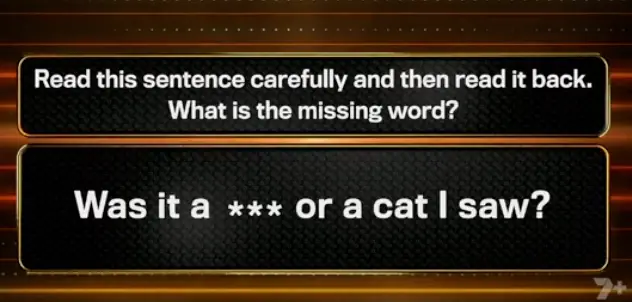
At first glance, it looked almost too easy to be a The 1% Club question.
Contestants were shown a familiar-looking sentence with just three letters missing:
“Was it a *** or a cat I saw?”
There was no complicated calculation to perform and no obscure word to identify. The challenge appeared to be simply finding a three-letter word that made the sentence complete.
Yet only 10 per cent of contestants were able to work out the answer.
The catch was that the missing word could not be solved by focusing only on the blank.
The clue was hidden in the whole sentence

Contestants had a limited amount of time to work out what belonged in the gap.
The natural instinct was to look at the words surrounding the missing letters and search for something that made grammatical sense:
“Was it a ___ or a cat I saw?”
Several possibilities might initially seem plausible. But the real clue was sitting elsewhere.
The question required contestants to read the sentence carefully — and then consider what happened when it was read in reverse.
Once the word “car” is inserted, the sentence becomes:
“Was it a car or a cat I saw?”
And that is where the puzzle finally reveals its trick.
The answer is “car”
The completed sentence is a palindrome — a sequence that reads the same forwards and backwards when spaces and punctuation are ignored.
That means:
Was it a car or a cat I saw?
contains the same sequence of letters in either direction.
The question therefore was never really about finding an ordinary three-letter word to complete a sentence. Contestants had to recognise the unusual structure of the entire phrase.
That extra step is what made such a short and apparently straightforward question surprisingly difficult under time pressure.
Why The 1% Club questions can be so deceptive

Hosted by Lee Mack, The 1% Club is built around logic, reasoning and problem-solving rather than conventional general-knowledge trivia.
Its questions are often designed to encourage an immediate answer before forcing players to reconsider the wording or structure of the problem.
The missing-word palindrome is a perfect example. Instead of asking contestants to search for the right word in isolation, it rewards those who notice a property of the sentence as a whole.
And this is far from the only type of puzzle on the show that can catch people out.
The famous bat-and-ball problem
Another well-known example asks:
“A bat and a ball cost £1.10 in total. The bat costs £1 more than the ball. How much does the ball cost?”
The correct answer is 5p.
That may seem counterintuitive because 10p is often the first answer that comes to mind.
But if the ball cost 10p, the bat would cost £1.10. Together, the two would cost £1.20 — not £1.10.
The correct calculation is:
- Ball: 5p
- Bat: £1.05
- Total: £1.10
The bat is therefore exactly £1 more expensive than the ball.
The real challenge is overcoming the obvious answer

Both puzzles demonstrate what makes The 1% Club so effective.
The palindrome question encourages players to concentrate on the missing word, while the bat-and-ball puzzle can push people towards an instinctive calculation.
In each case, the solution becomes much easier once the problem is approached differently.
That is why questions that look almost effortless on screen can become surprisingly frustrating when the clock is running.
Sometimes, the hardest part is not knowing the answer — it is realising that you have been looking at the question in the wrong way.