
“A young married couple doesn’t need two bedrooms.”
Several relatives nodded as though Charles had just offered the most practical solution in the world.
One of Adrian’s aunts leaned forward with sudden enthusiasm. “Eleanor’s antique furniture would look magnificent near those windows.”
Another relative immediately began discussing which bedroom should become Eleanor’s dressing room. Someone suggested replacing my dining table because it was “too modern” for her taste. Someone else wondered whether my building allowed private decorators to work on weekends.
They were redesigning my home while I was still sitting in it.
Then Charles added, almost casually, “Claire will also transfer twenty-eight hundred dollars into Eleanor’s account every month for living expenses.”
I stared at him.
“Twenty-eight hundred dollars?”
“It’s hardly unreasonable,” Eleanor said. “You earn more than enough.”
Slowly, I turned toward my husband.
Adrian sat beside me in an expensive charcoal suit, rotating his wineglass between two fingers. He did not look at me.
“Adrian.”
He lifted the glass to his mouth and took a drink.
That was his answer.
For the next fifteen minutes, his family dismantled my life as if I were not sitting three feet away.
They selected a moving date.
They discussed storage companies.
They decided Adrian and I could rent a one-bedroom apartment outside San Francisco to save money.
One cousin suggested Oakland.
Another said Eleanor should have access to my bank account so she would never have to “ask” for the monthly transfer.
Not one person asked whether I agreed.
Because my permission had never been part of their plan.
Finally, I placed my fork beside my plate.
“No.”
That one word silenced the room.
Eleanor blinked slowly. “I beg your pardon?”
“My condo is not being transferred to you,” I said. “You are not moving into it.”
Her expression changed.
“You will not receive access to it, and I will not send you twenty-eight hundred dollars every month.”
“You would deny an older woman a safe place to live?”
“You own three homes.”
Several relatives shifted in their chairs.
Eleanor’s jaw tightened.
Charles leaned forward. “This family has supported you since the day Adrian brought you into it.”
“No,” I replied. “This family has tolerated me because you assumed my income would eventually become yours.”
Adrian finally put down his glass.
“How can you speak to my parents like that?”
I turned toward him.
“They just divided up my property in front of me, and you said nothing.”
“My mother needs that condo.”
“Then buy her one.”
His expression hardened.
“You’re my wife.”
“I am not your family’s bank account.”
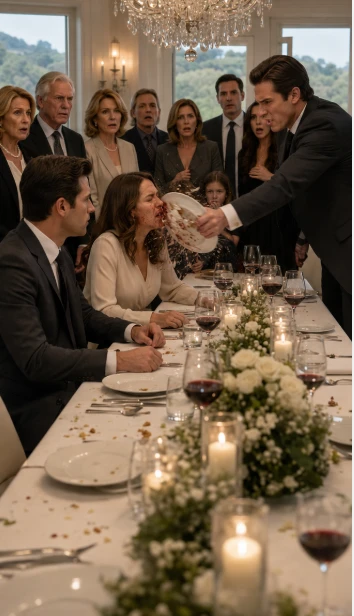
The dining room went painfully still.
Adrian pushed his chair backward and stood.
“You’re humiliating me in front of everyone.”
I held his gaze.
“No, Adrian. You’re doing that all by yourself.”
For a moment, nobody spoke.
Then Charles reached toward the leather briefcase beside his chair.
That was when I realized dinner had never been only a conversation.
He placed the briefcase on the table, opened it, and removed a neat stack of papers.
“I was hoping we wouldn’t need to make this unpleasant,” he said.
He slid the first document toward me.
At the top was my full legal name.
Underneath it was the address of my condominium.
And below that was a transfer document.
My stomach tightened.
“You prepared paperwork?”
“It’s only a draft,” Charles said quickly.
Eleanor folded her hands in front of her. “We thought it would be easier if everything were ready.”
I looked at Adrian.
He still would not meet my eyes.
That hurt more than anything else that had happened that evening.
Because suddenly I understood that he had known.
He had known before we arrived.
He had probably known for days.
Maybe weeks.
This entire dinner had been designed around one assumption: that enough people surrounding me would make saying no feel impossible.
I pushed the documents back across the table.
“No.”
Charles did not touch them.
“Claire, think carefully.”
“I already have.”
Adrian stepped closer to the table.
“You’re not leaving this room until we work this out.”
Every eye turned toward him.
I slowly picked up my handbag.
“There is nothing to work out.”
He moved toward the doorway, not touching me, but placing himself directly in the path I would have to take to leave.
That changed the atmosphere immediately.
Until then, the family had been pretending this was a discussion.
Now even they seemed to understand how it looked.
“Move,” I said.
Adrian’s voice dropped.
“Sit down.”
“No.”
“Claire.”
“Move away from the door.”
Eleanor rose. “Everyone needs to calm down.”
“I am calm,” I said. “I am also leaving.”
Adrian remained where he was.
My hand went into my handbag.
When I pulled out my phone, his face changed.
“Who are you calling?”
“Someone who can make sure I leave this house without being pressured into signing anything.”
“Don’t be ridiculous.”
I dialed 911.
The room erupted at once.
Charles stood.
Eleanor rushed around the table.
Several relatives began talking over one another.
“Claire, stop.”
“This is unnecessary.”
“No one has done anything.”
“This is a family matter.”
I held up one hand.
The dispatcher answered.
I gave the address.
“My husband and his family are pressuring me to sign documents transferring my property,” I said. “I have asked to leave, and my husband is standing in the doorway refusing to move.”
Adrian immediately stepped aside.
I noticed that.
So did everyone else.
“There,” he said. “I moved. Happy?”
I kept talking to the dispatcher.
“There are approximately twenty adults here. I would like officers present while I leave, and I want the documents on this table recorded because they were prepared without my knowledge.”
Charles grabbed the papers.
Maya stood so quickly that her chair tipped backward.
“Leave them there.”
Everyone looked at her.
She had barely spoken all evening.
Now her face had gone pale.
Charles stared at her.
“Maya.”
She swallowed.
“Don’t touch those papers.”
Adrian looked at his brother’s wife as though she had suddenly become a stranger.
“What are you doing?”
Maya looked at me.
Then at my phone.
Then toward the hallway.
Her hands were trembling.
But when she spoke again, her voice was clear.
“Claire isn’t the first.”
The room changed.
No one asked what she meant.
That told me more than any explanation could have.
The rest of the story is in the first comment.
Sirens became audible outside a few minutes later.
The soft sound moved closer through the quiet vineyard until red and blue light began reflecting against the dining-room windows.
Eleanor looked toward Charles.
Charles looked toward Adrian.
And Adrian looked toward Maya.
Maya looked at me with the expression of someone who had waited years for another person to ask the right question.
An officer appeared at the front entrance.
Then another.
One remained near the doorway while the other approached me.
I explained what had happened as calmly as I could.
I showed him the transfer papers.
I explained that the condo had been purchased before my marriage and remained solely in my name.
I explained the proposed monthly payments.
I explained that nobody had asked for my permission before discussing a move-in date.
Charles repeatedly attempted to interrupt.
“It was only a family discussion.”
The officer held up a hand.
“I’ll speak with everyone separately.”
That sentence seemed to frighten them more than anything else.
Separately.
Without the ability to correct one another.
Without the chance to coordinate an explanation.
Without Charles controlling the room.
Maya stared at the floor for several seconds.
Then she raised her head.
“There’s something else.”
Charles immediately said her name again.
“Maya.”
This time she did not flinch.
She looked directly at the officer.
“Tell them to check the basement.”
Silence.
The officer glanced toward her.
“What’s in the basement?”
Charles answered before Maya could.
“Storage.”
Maya shook her head.
“No. Not just storage.”
Adrian’s expression changed.
“Maya, stop.”
She turned toward him.
“I should have stopped a long time ago.”
Then she reached into the small handbag hanging from her chair and removed a folded document.
“I took this from downstairs three weeks ago.”
Charles moved forward.
The officer stepped between them.
Maya handed over the paper.
“It has my name on it,” she said. “But that isn’t my signature.”
I felt the air leave my lungs.
The officer studied the document without commenting.
“What is it?”
“A financial authorization form.”
Maya’s voice was barely above a whisper now.
“It gives Charles permission to move money from an account my grandmother left me.”
Charles scoffed.
“This is absurd.”
Maya continued as though he had not spoken.
“There are folders downstairs. Mine is there. Claire has one too.”
I stared at her.
“What?”
“I saw it last week.”
Adrian closed his eyes.
Only for a second.
But I saw it.
And in that moment, I knew.
He had known about more than dinner.
As Facebook doesn’t allow us to write more, you can read more under the comment section. If you don’t see the link, you can adjust the Most Relevant Comments Option to All Comments.
The officers did not immediately rush downstairs.
Instead, they separated everyone, photographed the documents already visible in the dining room, recorded our statements, and told Charles not to remove or destroy anything while the matter was being evaluated.
When one officer asked whether Charles would consent to showing them the basement storage area, he refused.
Too quickly.
Too firmly.
“It contains private family records.”
Maya gave a small, humorless laugh.
“That’s exactly the problem.”
The officer asked Maya how she knew what was downstairs.
She explained that she had been sent there several times over the years to retrieve tax boxes and old family records. Three weeks earlier, while searching for one of her children’s stored school projects, she had noticed a filing cabinet that had not been there before.
One drawer had been left slightly open.
Inside were folders bearing names.
Her name.
The names of several relatives by marriage.
And mine.
She had opened hers first.
That was how she found the authorization form.
Then she opened my folder.
Inside were copies of my condominium records, estimates of its current market value, printouts showing monthly homeowners’ association fees, photographs from the real-estate listing from years earlier, and what appeared to be preliminary transfer paperwork.
There was also a handwritten note.
PRIMARY RESIDENCE FOR E.
Underneath it:
C. monthly support: 2,800.
My hands went cold.
The amount had not been invented at dinner.
The condo had not been suggested casually.
Everything had been researched.
Calculated.
Prepared.
I looked at Adrian.
“How long?”
He said nothing.
“How long have you known?”
His mother answered for him.
“Claire, this is getting completely out of proportion.”
I did not look at her.
“How long, Adrian?”
He finally met my eyes.
“About the condo?”
“Yes.”
“A few weeks.”
Maya shook her head.
“No.”
Adrian turned toward her.
She looked devastated.
“He knew before that.”
“Maya.”
“You brought the property records downstairs in May.”
My mind raced backward.
May.
Four months earlier.
I remembered Adrian asking whether I still kept the original condo documents in the safe.
At the time, he had said our accountant needed to know where important records were stored.
I had given him the combination because he was my husband.
He had spent ten minutes in the office.
Then he had told me everything was fine.
The memory now felt completely different.
“What did you take from my safe?”
“Nothing.”
“Did you photograph anything?”
His silence answered me.
The officer noticed.
So did Maya.
I felt strangely calm.
The kind of calm that comes after confusion disappears.
For months, I had been trying to understand little things.
Why Adrian suddenly asked what my condo was worth.
Why Eleanor repeatedly commented that two bedrooms were “wasted” on us.
Why Charles wanted to know whether I had ever considered putting property into a family trust.
Why Adrian had begun asking how much money remained in my checking account after expenses.
I had treated each question separately.
Now they formed one continuous line.
This dinner was not the beginning.
It was the final step.
I turned to the officer.
“I want it documented that I do not consent to any transfer of my property, any access to my accounts, or any financial authorization involving these people.”
He nodded.
“Make that clear to your financial institutions and speak with an attorney as soon as possible.”
“I will.”
Adrian stepped forward.
“Claire, can we please talk alone?”
“No.”
“Five minutes.”
“No.”
“You’re my wife.”
“And you helped your family prepare documents involving my property without telling me.”
“I was trying to keep the peace.”
I almost laughed.
Instead, I looked at him carefully.
“Whose peace?”
He had no answer.
One of the officers escorted me outside.
I did not return to the dining table.
I did not finish dinner.
I did not collect the scarf I had left over the back of my chair.
I took only my handbag, my coat, and photographs of the papers that had been placed in front of me.
Maya followed me onto the front porch.
Her eyes were wet, but she kept her voice steady.
“I’m sorry.”
“You don’t need to apologize to me.”
“I knew something was wrong. I just didn’t know how far it went.”
“Why didn’t you say anything before tonight?”
She looked back through the windows.
Inside, her husband was speaking quietly with Adrian.
Charles stood by the fireplace with his arms folded.
Eleanor was seated again, perfectly still.
“Because when it happened to me, they convinced me I was imagining it.”
I waited.
Maya looked down at her hands.
“My grandmother left me money eight years ago. It wasn’t enormous, but it was mine. Charles said he could invest it for us. My husband agreed. I kept saying I wanted to leave it where it was.”
“What happened?”
“A few months later, most of it had been moved into a family investment company.”
“You signed the transfer?”
“I thought I did.”
She gave a bitter smile.
“They put a stack of tax documents in front of me and told me where to sign. I didn’t understand that one page gave them much broader authority than they had explained.”
My stomach tightened.
“Did you get the money back?”
“Some.”
“And the rest?”
“I stopped asking.”
“Why?”
She looked toward the house again.
“Because every time I asked, I became the problem.”
That sentence stayed with me.
I became the problem.
It was the entire family system summarized in four words.
If someone questioned Charles, that person was disrespectful.
If someone disagreed with Eleanor, that person was selfish.
If someone protected their own money, they were greedy.
If someone asked for documentation, they did not trust family.
And if someone tried to leave a conversation, they were creating drama.
There was always a new accusation waiting for the person who said no.
I touched Maya’s arm.
“You said there is a folder with my name downstairs.”
“Yes.”
“What else was inside?”
“I only looked for a minute. I was afraid someone would come down.”
“Did you see any signatures?”
She hesitated.
“One.”
My heart sank.
“Mine?”
“I think so.”
“On what?”
“A page about financial authorization.”
“I never signed anything like that.”
“I know.”
“How?”
“Because the signature looked almost identical to the one on the Christmas card you sent us last year.”
For several seconds, neither of us spoke.
Then I understood what she was suggesting.
A copied signature.
Not proof yet.
Not something I could accuse anyone of without examination.
But enough for me to act immediately.
I spent that night at a hotel rather than returning to the condo.
Not because I believed anyone was waiting there, but because I wanted twenty-four hours in a place nobody in Adrian’s family controlled.
I locked the door.
Put my phone on the desk.
And began making a list.
Bank.
Credit cards.
Condo records.
Insurance.
Passwords.
Email.
Cloud storage.
Tax documents.
Beneficiaries.
Emergency contacts.
Every part of my life that had slowly become intertwined with Adrian had to be reviewed one item at a time.
By seven the next morning, I had changed every password I could change online.
At eight, I called my bank.
At eight-thirty, I contacted the company that held my investment accounts.
At nine, I called the county recorder’s office and asked how to monitor filings connected to my property.
At nine-fifteen, I called a real-estate attorney.
At ten, I called a divorce attorney.
Adrian called twenty-three times before noon.
I answered none of them.
His messages changed tone as the morning progressed.
The first was angry.
“You embarrassed me in front of my entire family.”
The second was defensive.
“Those documents were drafts. Nobody was forcing you to sign anything.”
The third was almost gentle.
“My parents got carried away. I should have stopped them.”
Then came the apology.
“I’m sorry I didn’t handle dinner better.”
Not “I’m sorry I helped plan this.”
Not “I’m sorry I let people prepare documents involving your property.”
Not “I’m sorry I knew for months.”
He was sorry he had not handled dinner better.
By early afternoon, his messages became frightened.
“Please don’t talk to lawyers until we speak.”
That was the message that convinced me I was doing exactly the right thing.
My attorney, a calm woman named Laura, listened without interrupting as I described the previous evening.
When I finished, she asked one question.
“Before last night, did you ever authorize Adrian, Charles, or Eleanor to act on your behalf regarding the condo?”
“No.”
“Did you ever agree to transfer ownership?”
“No.”
“Did you ever authorize a monthly payment to Eleanor?”
“No.”
“Then keep saying no.”
She requested copies of everything I had photographed.
Within two hours, she had helped me send written notices stating that nobody had permission to represent me in connection with my condo or finances.
She also advised me to request copies of recent public records connected to the property.
Nothing had been transferred.
That was the first good news I received.
The second arrived two days later.
Maya called.
“I spoke to a lawyer.”
I smiled despite everything.
“Good.”
“And I gave the police photographs.”
“What photographs?”
“The basement.”
She had taken them weeks earlier.
At the time, she had not known what she would do with them.
She had simply known that if she ever confronted the family without proof, the folders might disappear.
So she had photographed the open filing cabinet.
The labels.
Several spreadsheets.
Her own paperwork.
And portions of my file.
One photograph showed a spreadsheet with columns for names, property, estimated value, account access, monthly contribution, and status.
Beside my name was my condo.
Beside Maya’s name was her inheritance account.
There were other names too.
Women who had married into the family.
A former spouse.
A cousin’s widow.
People I had seen at holidays without ever realizing they had stories similar to ours.
The police did not tell us what would happen next.
They did not make dramatic promises.
They simply collected statements and records and referred the financial questions for further review.
Several days later, investigators obtained legal authorization to examine materials connected to the allegations.
By then, Charles had hired an attorney.
So had Eleanor.
Their version of events was simple.
Everything had been ordinary family estate planning.
The documents were only drafts.
The spreadsheet was merely a planning tool.
Nobody had intended to deceive anyone.
The monthly contributions were voluntary.
The condo discussion had been hypothetical.
But hypothetical plans normally do not include a moving date.
Hypothetical transfers normally do not include prepared documents.
And voluntary payments normally begin with the person who is supposed to pay them actually volunteering.
More records surfaced.
Emails.
Draft agreements.
Messages between Adrian and Charles.
One message from three months earlier made me sit motionless in Laura’s office.
Charles had written:
She’ll resist at first. Let the whole family explain why it makes sense.
Adrian had replied:
I know. She hates being the only person saying no.
I read it three times.
Not because I could not understand it.
Because I could.
My husband knew exactly which part of my personality they intended to use against me.
I had spent years trying to be reasonable.
I hated unnecessary conflict.
I disliked making scenes.
I usually gave people the benefit of the doubt.
To a healthy person, those qualities were kindness.
To Adrian and his family, they were leverage.
Another message concerned the twenty-eight hundred dollars.
Adrian had written:
Start higher if you want. She may agree to 2800 if she thinks it’s the compromise.
There it was.
My generosity had been turned into a negotiation strategy.
My silence had been mistaken for permission.
My desire for peace had been mistaken for weakness.
I filed for divorce the following week.
Adrian came to the condo after receiving the papers.
By then, the locks had been changed, and Laura had instructed me not to meet him alone.
We spoke in the building lobby with my attorney’s assistant nearby.
He looked exhausted.
“This is really what you want?”
I almost could not believe the question.
“What I wanted was a husband who would tell his family that my home belonged to me.”
“I made a mistake.”
“You participated in a plan.”
“I didn’t think it would go this far.”
“You discussed my reaction in advance.”
He looked away.
“My father has always been controlling.”
“You’re thirty-six years old, Adrian.”
“I know.”
“Then you had choices.”
He finally looked at me again.
“I was trying to protect our marriage.”
“From what?”
He had no answer.
I understood then that he had never been protecting our marriage.
He had been protecting his position inside his family.
As long as I cooperated, he could have both.
My income and their approval.
My condo and their gratitude.
My marriage and his parents’ control.
The moment I said no, he had been forced to choose.
And at that dining table, he had made his choice.
“I love you,” he said.
I believed he believed it.
That was the strangest part.
But love that required me to surrender my judgment, property, privacy, and financial independence was not a love I wanted to keep.
“I hope you figure out why you thought this was acceptable,” I said.
Then I walked to the elevator.
He did not follow.
The months that came afterward were less dramatic than that dinner, but far more important.
There were lawyers.
Statements.
Financial reviews.
Property records.
Long conversations that revealed how thoroughly the family had normalized control.
Maya challenged the old financial authorization connected to her inheritance.
Another relative came forward after hearing that questions were being asked.
Then another.
Some situations were legally different from mine.
Some people had knowingly signed documents they later regretted.
Others said they had not understood what they were signing.
Investigators had to separate bad family behavior from conduct that might actually violate the law.
It was slow.
Complicated.
Nothing like television.
But the basement records made one thing impossible for Charles and Eleanor to maintain.
They could no longer claim that my dinner had been spontaneous.
My name had been in that cabinet before anyone invited me to the vineyard.
The condo had been researched.
My income had been discussed.
The monthly amount had been calculated.
And my likely objections had been anticipated.
The dinner was not a misunderstanding.
It was a strategy meeting disguised as a family gathering.
Months later, my attorney called with another update.
The financial investigation was still moving through the appropriate process, but several disputed documents were now being professionally examined.
I asked the question that had been bothering me.
“What happens if nobody is ever charged with anything?”
Laura was quiet for a moment.
“Then you still protected yourself.”
That answer changed something in me.
Until then, part of me had been waiting for an official institution to tell me that I had been right to leave.
A judge.
An investigator.
A prosecutor.
Someone with a title.
But I did not actually need a dramatic verdict to know what had happened.
They had planned to take control of something that was mine.
They had expected my husband to persuade me.
They had expected the family to overwhelm me.
They had expected social pressure to do what direct permission could not.
And when I refused, their first concern had not been whether I felt betrayed.
Their concern had been whether I would expose the plan.
That was enough.
The divorce took nearly a year.
The condo remained mine.
I did not sell it.
Everyone assumed I would.
Even Maya asked once whether living there reminded me of Adrian.
It did at first.
For several weeks, every room seemed connected to a memory.
Adrian making coffee.
Adrian leaving his shoes beside the couch.
Adrian complaining that the second bedroom was too small for a proper office.
Eleanor standing near the windows during Thanksgiving and saying how beautiful her antique cabinet would look there.
That memory used to make me angry.
Eventually, it made me laugh.
I kept the windows exactly as they were.
I kept my dining table.
I turned the second bedroom into an office.
Not because I needed a dramatic symbol of independence.
I simply liked having two bedrooms.
One afternoon, almost a year after the dinner, Maya came to visit.
She stood near the windows and looked around.
“So this is the condo everyone nearly lost their minds over.”
I smiled.
“Apparently.”
She laughed.
It was the first time I had heard her laugh without immediately checking who else was in the room.
Her own life had changed too.
She had become far more careful with money, documents, and anything she was asked to sign.
She no longer allowed “family” to be used as an argument against basic boundaries.
Neither did I.
We sat at my supposedly replaceable dining table with coffee between us.
For a while we talked about ordinary things.
Her children.
Work.
A school event.
A terrible restaurant she had tried the week before.
Then she became quiet.
“I still think about that night.”
“So do I.”
“If you hadn’t called for help, I don’t know whether I ever would have said anything.”
I shook my head.
“You had already taken photographs.”
“That isn’t the same.”
“No. But you were getting ready.”
She considered that.
“Maybe.”
I looked toward the second bedroom.
For years, I had thought courage would feel dramatic.
Like certainty.
Like knowing exactly what to do.
It did not.
Sometimes courage was one quiet word at a dinner table.
No.
Sometimes it was taking a photograph because you were not yet ready to confront anyone.
Sometimes it was calling a lawyer the next morning.
Sometimes it was changing a password.
Sometimes it was telling someone else what you had seen.
And sometimes it was simply refusing to let twenty people convince you that something belonged to them when you knew it belonged to you.
Maya finished her coffee and stood to leave.
At the door, she paused.
“Did Eleanor ever apologize?”
“No.”
“Charles?”
“No.”
“Adrian?”
I thought about it.
“He apologized for the consequences.”
Maya nodded slowly.
“That sounds about right.”
After she left, I walked back into the living room.
Late-afternoon sunlight stretched across the floor.
The windows Eleanor had already claimed in her imagination filled the room with gold.
For the first time, I realized the condo no longer felt like the place they had tried to take from me.
It simply felt like home.
My home.
Not because a deed said so.
Not because a lawyer had confirmed it.
Not because an investigation had documented what happened.
Those things mattered.
But the real difference was simpler.
The night of that dinner, everyone around the table had acted as though my consent were an inconvenience they could eventually overcome.
I had spent years believing that being a good wife meant compromising.
Being generous.
Being patient.
Making room.
But there is a difference between compromise and surrender.
There is a difference between helping family and financing entitlement.
There is a difference between keeping peace and giving people permission to erase your boundaries.
They had mistaken all three.
So had I.
I never made that mistake again.
And every now and then, when I passed the second bedroom they had declared unnecessary, I remembered Charles sitting at that dining table and telling me a young married couple did not need two bedrooms.
In the end, he had been right about only one thing.
I did not need two bedrooms.
I wanted them.
And for the first time in a very long time, I understood that wanting something that belonged to me was reason enough to keep it.