Monster movies have spent decades proving that audiences will fall for almost any creature if the story around it is compelling enough.
Vampires, zombies, giant reptiles and stitched-together corpses have all become cinema staples. More recently, filmmakers have increasingly pushed monsters beyond straightforward horror, turning them into tragic figures, romantic leads and misunderstood outsiders.
Now Olivia Colman is fronting one of the strangest variations yet.
Wicker, the new fantasy-romance from writers and directors Alex Huston Fischer and Eleanor Wilson, centers on an ostracized fisherwoman who becomes so fed up with the people in her medieval village that she commissions a husband made entirely from wicker.
Then he comes to life.
And rather than becoming the terrifying creature everyone expects, the unlikely new arrival becomes the center of an increasingly passionate romance that sends the entire village into uproar.
The film opens in limited release on October 23 before expanding more widely on October 30.
Olivia Colman plays a woman who decides she has had enough
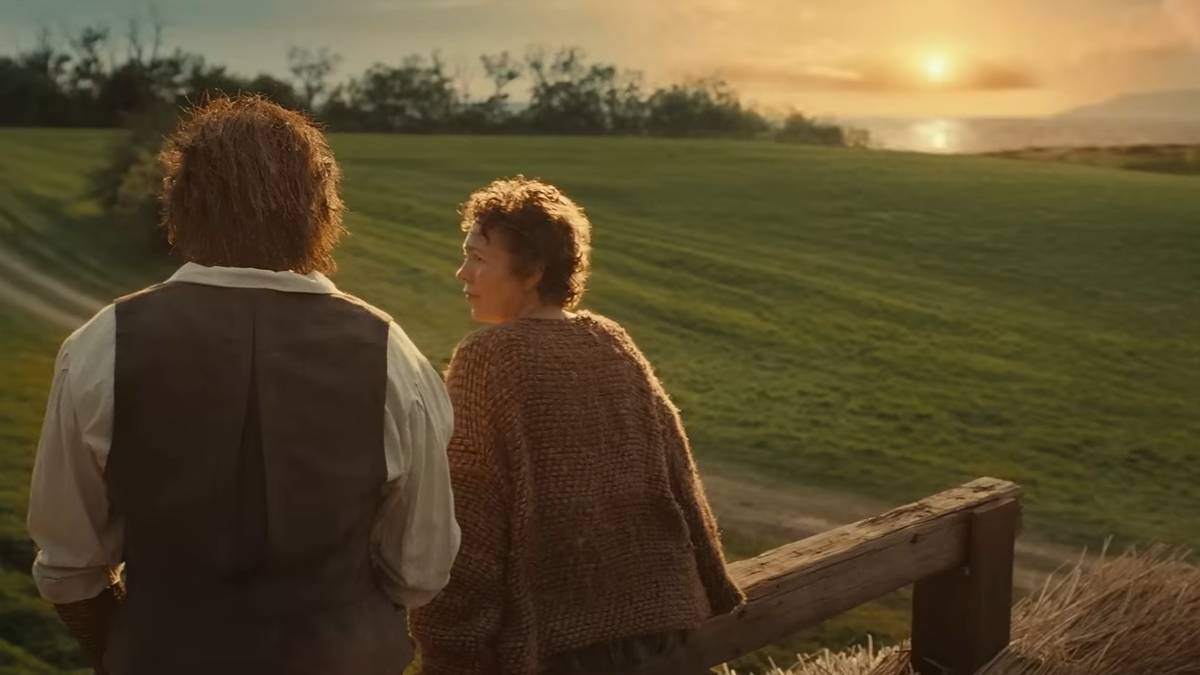
Colman stars as the Fisherwoman, an unmarried woman living on the outskirts of a conservative seaside village.
She is mocked by those around her, looked down upon because of her profession and repeatedly judged for remaining single.
Eventually, she decides she has had enough.
Instead of continuing to endure the ridicule, she seeks out the local Basketmaker, played by Peter Dinklage, with one extraordinary request: make her a husband.
He does.
Alexander Skarsgård plays the resulting Wicker Husband, a handcrafted figure whose arrival immediately changes the Fisherwoman’s life.
According to the film’s official synopsis, their unconventional relationship quickly provokes “outrage, jealousy and chaos” among the villagers.
It is a premise that sounds absurd on paper.
That absurdity is also exactly what makes it difficult to ignore.
The monster is not the villain this time
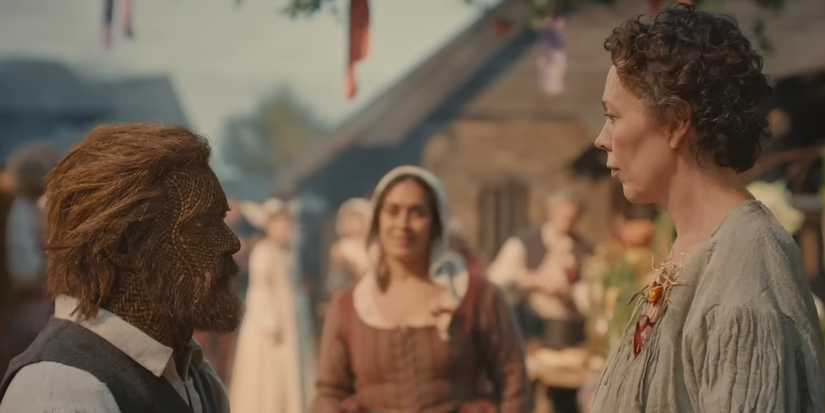
Traditional monster stories often begin with one basic assumption: the creature represents the danger.
Wicker appears determined to turn that expectation around.
The Wicker Husband may look completely inhuman, but the central conflict is not about villagers protecting themselves from a murderous beast.
Instead, it is their reaction to a relationship they cannot understand.
Skarsgård’s character is presented as soulful and affectionate, while the Fisherwoman discovers something in the strange new marriage that she was unable to find among the supposedly respectable people surrounding her.
That makes the film part of a much broader evolution in monster storytelling.
The creature is no longer automatically the thing audiences should fear.
Sometimes the people staring at it are.
A ridiculous idea treated like a genuine romance
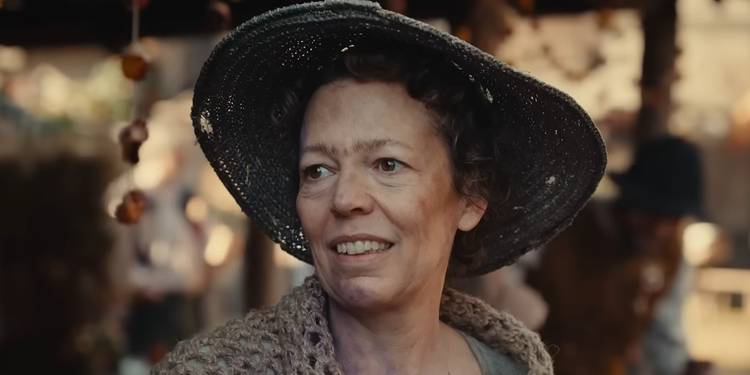
That tonal balance may be Wicker‘s biggest gamble.
A woman falling passionately in love with a wicker man could easily become a one-joke comedy.
Instead, the filmmakers appear to be embracing both sides of the premise.
The situation is inherently funny, but the romance is not being treated as disposable.
The official description calls the film an “audacious comedic fable about sex, marriage, and the absurdities of social convention,” suggesting that the deliberately bizarre relationship is being used to examine considerably more familiar human behavior.
The stranger the romance becomes, the more conventional the villagers begin to look in comparison.
Their jealousy, judgment and obsession with conformity provide the film with a recognizable emotional foundation beneath all the fantasy.
Alexander Skarsgård faced an unusual challenge
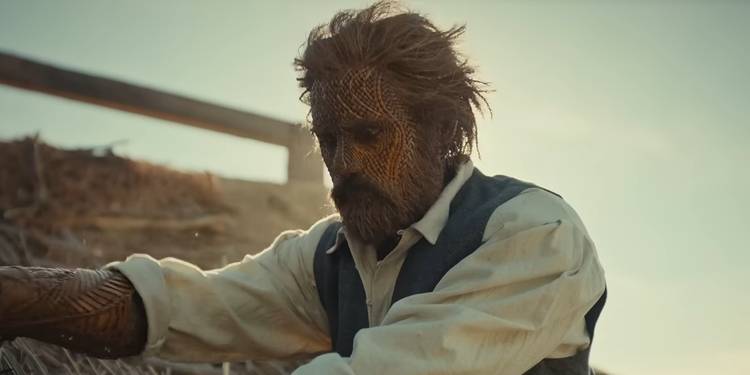
Playing a living wicker husband also required something very different from an ordinary romantic lead.
Skarsgård performed inside an elaborate handmade wicker costume created by Wētā Workshop in New Zealand.
He recently described the physical demands of working inside the intricate suit, which could become particularly uncomfortable beneath strong lights.
The actor also joked that finding the character’s physical stiffness was not especially difficult, given his own age.
More surprisingly, he said the harder challenge was playing such an unusually wholesome figure.
Skarsgård reportedly looked toward Tom Hanks as inspiration for the character’s essential goodness.
That detail says a great deal about how the film wants viewers to see its monster.
He may resemble something constructed for a horror movie, but his emotional function is closer to an idealized romantic partner.
Olivia Colman gives the bizarre story a serious anchor
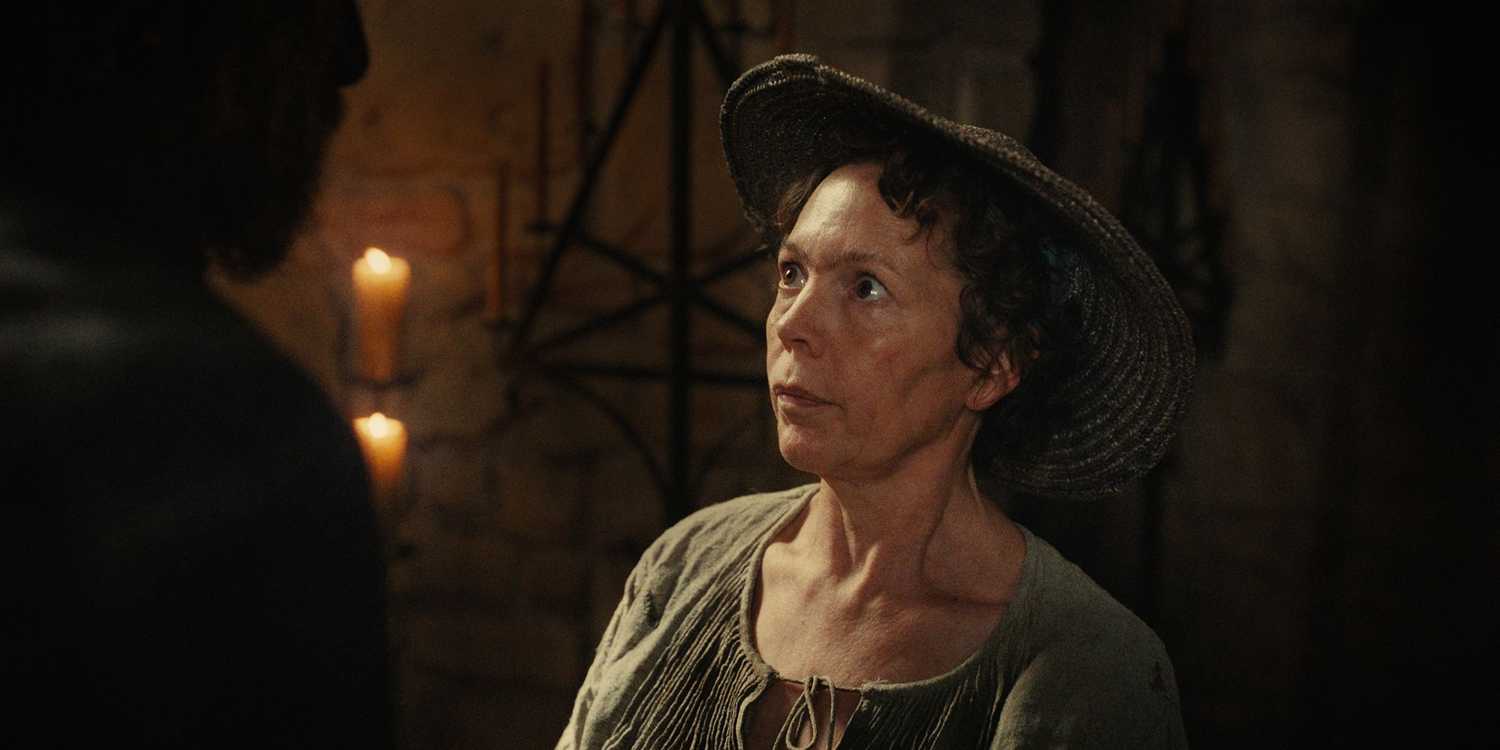
A premise this eccentric also depends heavily on its lead performer.
Colman has built much of her career around characters who can shift between comedy, vulnerability and emotional intensity without making those transitions feel forced.
That versatility makes her unusually well suited to a story in which the audience has to accept something completely ridiculous while still caring about the woman at its center.
The directors have praised Colman’s instinctive approach to the character, noting that she could move quickly between comedy and emotional sincerity.
That may prove essential.
If the Fisherwoman’s loneliness, frustration and eventual happiness feel real, the wicker husband becomes easier to accept as something more than a visual gag.
Elizabeth Debicki adds another layer of suspicion
Elizabeth Debicki also appears among the film’s central cast, alongside Dinklage and Skarsgård.
Her character is connected to the growing suspicion surrounding the unconventional couple.
As fascination with the Fisherwoman’s marriage spreads, the relationship increasingly destabilizes the village’s existing social order.
That conflict allows Wicker to push beyond the simple novelty of its central creature.
The wicker husband becomes a disruption.
His very existence forces the community to confront its assumptions about marriage, desirability and who gets to decide what a respectable relationship should look like.
The villagers may consider the Fisherwoman strange.
Her happiness appears to be what truly unsettles them.
Monster movies have always been more flexible than they look
That idea fits comfortably within the long history of monster cinema.
Monsters have never belonged exclusively to horror.
King Kong combined spectacle with tragedy.
Godzilla became both destructive force and cultural icon.
Frankenstein transformed an impossible scientific experiment into a story about loneliness, rejection and responsibility.
More recent films have pushed the emotional possibilities even further.
The Shape of Water placed romance between a human woman and an amphibious creature at the center of an Oscar-winning fantasy.
Lisa Frankenstein reworked the reanimated corpse into a teenage romantic fantasy.
Guillermo del Toro’s Frankenstein again revisited the idea of the monster as something capable of provoking sympathy rather than simple terror.
That lineage helps explain why Wicker does not feel quite as disconnected from traditional monster storytelling as its premise initially suggests.
The material may be unusual.
The emotional idea is not.
Why audiences keep returning to monsters
Part of the enduring appeal of monsters is that they allow stories to exaggerate familiar human fears and desires.
A vampire can represent seduction, immortality or predation.
A zombie can embody fears about disease, conformity or societal collapse.
Frankenstein’s creature can become a symbol of rejection and the consequences of creating life without accepting responsibility for it.
The creatures themselves do not need to be realistic.
Their emotional meaning does.
That freedom allows monster stories to move easily between horror, science fiction, tragedy, comedy and romance.
Wicker pushes that flexibility into particularly strange territory.
Its creature does not seem primarily interested in terrifying anyone.
He exists to love someone.
The misunderstood monster has become increasingly important
Modern audiences have also become much more accustomed to monsters who are not villains.
Instead of simply functioning as obstacles for human heroes to defeat, creatures are increasingly portrayed as outsiders whose appearance causes others to misjudge them.
That change gives filmmakers room to explore prejudice and social conformity without abandoning the fantasy elements that make monster stories so visually distinctive.
The Wicker Husband fits neatly into that tradition.
He is obviously not human.
But according to the film’s premise, his capacity for affection appears to be considerably less troubling than the behavior of the humans around him.
That inversion gives the story its most interesting question.
If an artificial man made from woven branches can offer genuine companionship, what exactly makes the supposedly normal villagers superior?
An original idea arriving in a sequel-heavy marketplace
There is another reason Wicker has attracted attention.
It is difficult to mistake it for anything else currently arriving in cinemas.
Large portions of the contemporary theatrical marketplace are built around recognizable intellectual property, sequels, reboots and established franchises.
Wicker arrives with none of those obvious advantages.
The film is adapted from Ursula Wills-Jones’ short story The Wicker Husband, but for most moviegoers the premise will still feel completely unfamiliar.
That makes its theatrical release an interesting test.
Audiences are being asked to turn up not because they already know the character, but because the concept itself is strange enough to spark curiosity.
The film already became difficult to ignore
The trailer has helped push that curiosity even further.
Seeing Skarsgård transformed into a full-size woven romantic lead gives the premise an immediate visual hook that is difficult to communicate with a simple plot description.
The costume is elaborate rather than intentionally cheap-looking, which helps the film commit fully to its fantasy world.
At the same time, the sight of Colman romantically interacting with a towering wicker man preserves the comedy inherent in the idea.
That combination has already generated considerable online attention.
The filmmakers told Entertainment Weekly that they have enjoyed seeing audiences respond to the unusual concept and the unexpected romantic energy surrounding Skarsgård’s character.
It could be more than just a bizarre novelty
The temptation with a film like Wicker is to reduce everything to its strangest image.
Olivia Colman marries a basket man.
That alone is enough to sell a trailer.
But the movie appears interested in more than simply sustaining that joke for 105 minutes. Its official descriptions repeatedly emphasize marriage, social convention, jealousy and the reaction of an intolerant community to a woman who finally refuses to behave as expected.
That could give the film considerably more staying power than its deliberately outrageous premise suggests.
The best monster stories have rarely been only about monsters.
They use impossible creatures to expose something recognizable in the people surrounding them.
A very different monster is coming this fall
Whether audiences embrace Wicker remains to be seen.
Its October release will place a distinctly unusual romantic fantasy into a crowded fall movie season, and its success will depend partly on whether viewers are willing to follow the premise beyond the initial joke.
But its existence alone shows how much room remains inside the monster genre.
The creature no longer needs to hide in a castle, rise from a laboratory or destroy a city.
Sometimes he can simply be handcrafted by Peter Dinklage, fall in love with Olivia Colman and accidentally cause an entire medieval village to lose its mind.
After more than a century of monster movies, finding something that genuinely feels new is increasingly difficult.
A devoted husband made from wicker might just qualify.