Monster: The Lizzie Borden Story spends much of its season immersed in murder, suspicion and the question of what really happened inside the Borden home.

Its finale does something far less expected.
Rather than ending with another axe blow or a definitive confession, Episode 8, “Carnival,” carries Lizzie Borden into the 20th century and imagines what happens after a woman escapes conviction but can never escape becoming synonymous with the crime.
The final chapter also completes the story of Aileen Wuornos, bringing two women separated by generations together in a surreal final scene about guilt, judgment and forgiveness.
And after everything Lizzie and Maggie have endured, the series gives them an ending that comes surprisingly close to happiness.
Warning: Major spoilers for Episode 8 follow.
Aileen Wuornos Faces The Death Penalty

The finale first returns to Aileen Wuornos, played by Sarah Paulson.
Aileen had previously appeared alongside her girlfriend Shelby as someone fascinated by Lizzie’s story.
Now her own life has become a murder case.
During her trial, Aileen tearfully testifies about killing Richard Mallory. She says Mallory attacked and sexually assaulted her and that she believed she was fighting for her life.
The episode also notes that Mallory had previously been arrested with intent to rape.
But Aileen is convicted.
After receiving a death sentence, she angrily lashes out at the jury, accusing them of “putting someone that was raped to death.”
Eventually, Aileen is executed by lethal injection.
At first, that appears to be the end of her story.
It isn’t.
Lizzie Has Everything — Except Freedom From Her Name
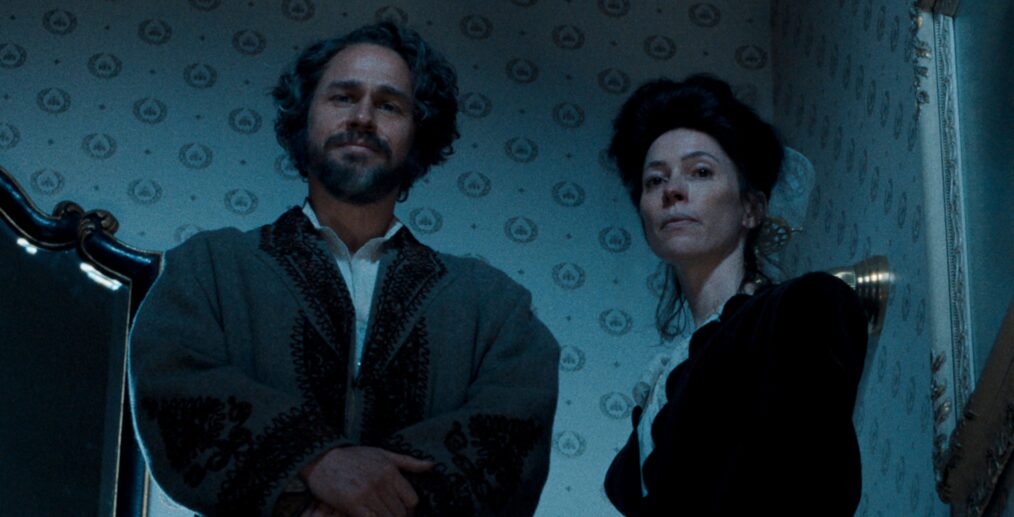
The episode also jumps forward following Lizzie’s acquittal.
By 1908, her life looks dramatically different.
Lizzie is living in an impressive mansion. She has surrounded herself with roughly 200 animals, replanted the cherry trees her sister once destroyed and embraced modern technology by installing electricity.
On the surface, she has won.
A jury found her innocent.
She has money.
She has a beautiful home.
But the Borden murders have followed her into that new life.
Emma has remained with her, yet the relationship between the sisters is increasingly strained.
Emma drinks heavily as a means of escape, while Lizzie has developed a friendship with actress Nance O’Neil, whom she previously helped during Nance’s own murder trial.
When Nance needs financial help as she prepares to move into film, Lizzie is willing to provide it.
A dinner party, however, exposes how badly life inside the Borden mansion has deteriorated.
Emma Calls Their Life A ‘Gilded Cage’

Surrounded by wealthy friends, an intoxicated Emma finally says what she has apparently been carrying for years.
She tried to leave.
But wherever she went, the Borden name followed.
Emma describes it as “a bit of an albatross.”
Instead of finding a new life, she returned to alcohol and “the demon poppy,” while continuing to honor the promise she made to their mother to protect Lizzie.
The sisters may live in luxury, but Emma believes they are prisoners.
She calls their existence “a gilded cage.”
And eventually the dinner conversation reaches the question that has haunted Lizzie since 1892.
Who killed Andrew and Abby Borden?
Lizzie Offers Three Other Suspects

Lizzie doesn’t confess.
Instead, she gives her guests several alternative theories.
Perhaps the killer was the Portuguese man linked to Bertha Manchester’s murder, who could have entered the Borden house intending to rob Abby before being interrupted.
Maybe Uncle John Morse was responsible, with his unexpected return to the family’s life making him suspicious.
Or perhaps the rumors about Andrew having an illegitimate son were true, and that secret child killed Andrew and Abby.
But Lizzie ultimately offers an even simpler explanation.
She claims it was random.
“Someone just walked into my family’s house and killed my dear parents,” she says.
“With an axe.”
The series still refuses to give the people around Lizzie the straightforward answer they want.
But someone from Lizzie’s past is about to return.
Maggie Comes Back

Later that night, Lizzie’s makeshift alarm signals that somebody has entered the basement.
She goes to investigate.
The mysterious visitor isn’t a burglar.
It’s Maggie Sullivan.
Lizzie and Maggie immediately embrace and kiss.
Maggie had helped Lizzie kill her parents before staying away during the trial, but her years apart from Lizzie have not produced the happy life she hoped to find.
She settled on a small farm in Ireland.
She married a man she despises.
Yet whenever possible, she has secretly returned to Lizzie for brief visits.
Maggie has technically escaped the Borden house.
Emotionally, she never really left.
Lizzie Discovers She Has Become A Monster In American Folklore
By 1911, Lizzie begins confronting something even an acquittal cannot erase.
Her own legend.
On Halloween, she encounters a young girl dressed as Lizzie Borden.
Lizzie’s response is immediate: she slaps her.
Elsewhere, she discovers a book identifying her as a murderer.
Children carry toy axes.
They sing the infamous rhyme inspired by the Borden killings.
The woman once accused of murder has become something bigger than the actual court case.
“You’re the boogeyman now, sister,” Emma tells her.
For Emma, it is the breaking point.
Emma Finally Leaves Lizzie
Emma announces that she is leaving — and this time she intends to stay gone.
Before departing, she gives her sister a brutal final message.
“I hope on your deathbed you admit to what you did.”
The accusation hangs over Lizzie even after Emma disappears from her life.
The sisters who once appeared bound together by family, secrecy and obligation are finally separated.
Meanwhile, another relationship is reaching its own breaking point in Ireland.
Maggie Nearly Repeats The Past
Maggie’s husband has become suspicious.
He wants to know where the money used to purchase their home came from, while his treatment of Maggie becomes increasingly unbearable.
For a moment, Maggie imagines returning to the solution that once connected her permanently to Lizzie.
An axe.
She imagines killing him.
But she doesn’t.
Instead of repeating the violence of the past, Maggie simply walks away.
Her destination is clear.
Lizzie.
‘No More Basements. No More Men.’
Maggie’s return is different this time.
Previously, their relationship existed in secrecy.
She entered through basements and disappeared again.
Now Maggie refuses to hide.
No more basements.
No more men.
She walks through Lizzie’s front door and chooses to stay.
For a season built around secrecy, violence and repression, it becomes one of the finale’s clearest moments of liberation.
Lizzie and Maggie finally build a life together.
And their attention turns toward something larger than themselves.
Lizzie And Maggie Become Suffragettes
The finale imagines Lizzie and Maggie becoming committed suffragettes.
Together, they work for women’s right to vote.
Their lives are no longer centered entirely on what happened inside the Borden house.
They find new purpose.
They find new passions.
Most importantly, they have each other.
For Lizzie, however, happiness doesn’t completely erase guilt.
She eventually turns toward religion.
Lizzie asks God to forgive her for the violence she has committed and pleads for grace.
That request becomes crucial to understanding the finale’s strange final scene.
Aileen Opens Her Eyes
The story returns one last time to Aileen Wuornos.
She has been executed.
But suddenly, Aileen’s eyes open.
She isn’t alone.
Waiting for her are Maggie and Lizzie.
The two storylines that have existed generations apart finally intersect.
Lizzie approaches a woman who, like her, became permanently associated with murder and transformed into a cultural symbol long after the details of the crimes became entangled with mythology.
But Lizzie isn’t there to judge Aileen.
She offers something else.
“All is forgiven,” Lizzie tells her.
“All is understood.”
What Does The Final Scene Mean?
The ending is deliberately surreal rather than literal.
Lizzie had previously asked God for forgiveness and grace.
In the final moments, she becomes the person offering that grace to someone else.
Aileen’s story has repeatedly echoed themes surrounding Lizzie’s: violence, abuse, public fascination, judgment and the transformation of a real woman into a notorious cultural figure.
Their circumstances are radically different, but Monster uses the final encounter to connect them thematically.
Aileen dies condemned by the state.
Lizzie dies having escaped legal punishment but never escaping public suspicion.
In the finale’s imagined afterlife, those earthly verdicts suddenly matter less.
Lizzie understands Aileen because she knows what it means to become something frightening in other people’s stories.
Lizzie Gets The Ending Nobody Expected
The season could have ended by solving its central murder mystery once and for all.
Instead, it leaves Lizzie’s public story unresolved while giving her private story closure.
Emma leaves.
Maggie returns.
Lizzie stops hiding their relationship and finds purpose in the suffrage movement.
She seeks forgiveness for her own violence.
And in the final supernatural flourish, she extends that forgiveness to Aileen.
The woman remembered for an axe becomes an unlikely figure of grace.
After an entire season asking whether Lizzie Borden was a monster, the finale leaves viewers with a very different question.
Not whether she can be judged — but whether even a monster can be forgiven.