Ezra Frech Makes a Subtle Point After Julianne Hough’s Choice of Words on DWTS
A brief exchange on Dancing With the Stars took an unexpected turn when Paralympic champion Ezra Frech quietly chose a different way to describe the disability community after host Julianne Hough used the phrase “differently abled”.
Rather than correcting Hough directly, the 21-year-old made his point through his own response, using the term “disabled community” as he spoke about the support he had received.
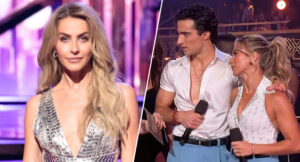
The moment came during Tuesday night’s semifinals, following an impressive jive with his professional partner, Daniella Karagach, 33.

Julianne Hough’s Question Prompted a Different Choice of Words
After Frech and Karagach performed to Kenny Loggins’ 1984 hit “Footloose”, Hough praised the athlete for inspiring others and asked what it meant to represent the community on such a prominent platform.
“You are honestly such an inspiration for the differently abled community, and you have truly made other people want to chase their dreams,” she said. “How does it feel to be on this stage and this platform being that person for them?”
Frech, who was born with a congenital limb difference, responded warmly. But when referring to the people supporting him, he used a different phrase.
“It’s the honor of a lifetime,” he said. “I’m beyond grateful seeing all the videos on social media. The support from the disabled community. It means the world to me.”
He did not openly challenge Hough. Instead, his wording offered a quiet reminder of the terminology preferred by many disability advocates.

Why the Word “Disabled” Matters
The distinction is more than a matter of personal preference.
The National Education Association explains that euphemisms such as “differently abled” and “challenged” can be viewed as condescending because they may imply that disability is something that needs to be softened or disguised.
The organisation notes that many disability advocates prefer straightforward language, including the words “disabled” and “disability”.
Frech’s response reflected that approach without turning the exchange into a confrontation.

Frech and Karagach Earned a Standing Ovation for Their Jive
The conversation followed a performance that had impressed all three judges.
Bruno Tonioli rose to his feet after the routine and declared: “A star is born!”
Carrie Ann Inaba also stood up, praising Frech for being “so controlled” and “so dynamic” before adding: “Bravo.”
Derek Hough admitted that the performance had made him “weirdly emotional”.
“Seeing what you did, I was, like, in awe. I was like, what am I watching here? This is incredible,” he said.
The praise was reflected in the scoreboard, with Frech and Karagach receiving a perfect score for their jive.
A Perfect Score Wasn’t Enough to Keep Them Out of Danger
Despite the judges’ enthusiastic reaction and their perfect score, Frech and Karagach still found themselves in the bottom two.
They narrowly avoided elimination, while Harry Shum Jr. and Jenna Johnson were sent home.
The result made an already eventful semifinal night even more dramatic. But beyond the competition, Frech’s brief exchange with Hough offered a reminder that the language used to describe disabled people matters — and that sometimes a point can be made without a public confrontation.
Dancing With the Stars airs Tuesdays at 8 p.m. ET/PT on ABC and Disney+.