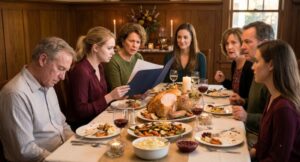
“Mom and Dad are signing the house over to me,” Victoria announced at Thanksgiving dinner, smiling as if the deed were already framed on her wall. “You’re not included.”
For a moment, nobody moved except my father’s knife, still working through a slice of turkey he suddenly seemed unable to cut.
Then the table came alive around her.
Aunt Carol put one hand to her chest and said, “Oh, Victoria, that’s wonderful.”
Uncle James lifted his glass. “Keeping it in the family. Eleanor would have liked that.”
My cousins smiled politely because family dinners had trained them to survive awkward moments by pretending not to notice them. My mother’s eyes moved to me, sharp and warning, the way they had moved to me my entire life whenever Victoria said something that should have embarrassed everyone else.
Be happy for your sister, that look said.
Do not ruin this.
Do not make this about you.
Victoria stood near the end of the table in a cream cashmere sweater, honey-blonde hair brushed perfectly over one shoulder, gold earrings catching the light above the turkey platter. She looked radiant, not with grief, not with gratitude, but with the glow of a woman who believed the world had finally delivered what it owed her.
“Mom and Dad thought about splitting it,” she continued, her voice softening in a way that made it more insulting, “but Jordan has Seattle. She has her career. She has her condo. She doesn’t need Grandma’s house.”
The dining room smelled of roasted turkey, sage stuffing, cranberry sauce, and the cinnamon candles my mother had insisted on lighting even though everyone knew they gave Uncle James a headache. The table was crowded with gravy boats, wine glasses, mashed potatoes, green beans, rolls under linen, and the pumpkin pie Aunt Carol had brought from a bakery and pretended was homemade.
Thanksgiving had always belonged at Grandma Eleanor’s house in Laurelhurst.
This year, my mother had insisted we gather at my parents’ house instead.
“Too hard emotionally,” she had said on the phone.
But twenty minutes into dinner, I understood the real reason.
Grandma’s empty chair would have ruined the performance.
Victoria looked directly at me now, waiting for the expression she wanted from me. Not joy. Not even agreement. Submission. She wanted me to perform my own erasure politely.
“You understand, right?” she asked. “I mean, you barely visited Grandma in the last few years.”
I had visited Grandma Eleanor once a month for ten years. I had driven three hours from Seattle on Friday nights after work, slept in her guest room with the faded blue quilt, made coffee in her yellow kitchen, and spent Saturday mornings pruning roses, sorting old photographs, fixing cabinet handles, or sitting beside her on the back deck while she told stories about Portland before everyone started buying houses for “investment potential.”
I called her every Sunday at seven.
Every Sunday.
Victoria had not visited her for fourteen months before the diagnosis.
But I did not say any of that.
My mother leaned toward me with a smile that did not reach her eyes.
“Jordan,” she said, “say something. Be happy for your sister.”
My father kept looking at his plate.
That was the first sign.
Dad had always been the official voice of family decisions, the man who cleared his throat before announcing things like college plans, holiday arrangements, retirement accounts, or which daughter was being “practical” and which one was “difficult.” If he truly believed this moment belonged to Victoria, he would have been beaming. He would have been talking. He would have been explaining how generous he and Mom were being.
Instead, his face had gone strangely dull.
His fork hovered above his plate, untouched.
I took a slow sip of water and set the glass down carefully beside my napkin.
Then I smiled.
“Dad,” I said, “should I tell them, or will you?”
The room went silent so fast I could hear the ice shift in Uncle James’s glass.
Dad’s fork slipped from his hand.
It hit his plate with a hard metallic clang that echoed through the dining room like a judge’s gavel.
Victoria’s smile froze.
She laughed once, thin and nervous. “Tell us what?”
I kept my eyes on Dad.
His face had gone pale. Not surprised. That mattered. He did not look like a man hearing impossible news. He looked like a man who had been hoping the impossible would not be said out loud.
My mother looked from him to me.
“What is happening?”
I reached down beside my chair and lifted the navy folder I had brought before anyone arrived. It had sat under my bag through appetizers, through the blessing, through Victoria’s announcement, quiet as a locked door.
Victoria’s eyes dropped to it.
For the first time that evening, she stopped looking like a woman receiving a gift and started looking like a woman standing too close to the edge of something she had not noticed.
“Jordan,” Mom said carefully. “What is that?”
“Paperwork.”
Dad closed his eyes.
That tiny movement told the whole table more than any speech could.
I placed the folder on the table beside the gravy boat and slid it toward him first.
“Read the grantee’s name,” I said. “Out loud.”
He did not touch it.
Uncle James lowered his glass.
Aunt Carol’s hand froze over her napkin.
Victoria’s fingers moved toward the folder, then stopped halfway, as if some part of her already knew that paper would not bend simply because she wanted it to.
“Dad,” I said again, softer this time. “You already saw it.”
My mother’s face changed.
“Saw what?”
I opened the folder just enough for the first page to show.
And before anyone read the second line, that dining room finally became what Grandma Eleanor had known it would become all along: a place where the story my family had told about me could no longer survive the evidence.
Victoria had been born first.
In the Matthews family, that was not a birth order. It was a coronation.
She came into the world three years before me, pink and loud and adored, and from the moment I could understand language, I understood that Victoria was the daughter my parents had expected and I was the daughter they had learned to manage.
When Victoria got a B in chemistry, Mom said, “She works so hard. Science just isn’t her thing.”
When I got a B in calculus, Dad said, “You’re capable of better. Why aren’t you applying yourself?”
When Victoria chose a state university because she wanted to stay close to home, they called it financially responsible.
When I earned a full scholarship to an Ivy League school, they said I was abandoning my roots.
When Victoria moved back home eight months after graduation, unable to afford rent because “paying a landlord was throwing money away,” my parents called it strategic.
When I took a job in Seattle and paid for my own apartment, they said I was distant.
That was the family language.
Victoria’s dependence was tenderness. Mine was selfishness.
Victoria’s mistakes were growing pains. Mine were character flaws.
Victoria’s wants were needs. My needs were inconveniences.
I stopped trying to correct the narrative somewhere around twenty-two. Correction requires an audience willing to hear it, and my family had already assigned every role.
Victoria was the charming one.
Victoria was the sensitive one.
Victoria was the one who “needed support.”
I was the practical one, which sounded like a compliment until you realized it meant I was expected to manage without comfort.
The only person who never spoke about me that way was Grandma Eleanor.
Eleanor Price was my mother’s mother, though she had never seemed to belong fully to my mother’s softness. Grandma was sharp, stubborn, and unsentimental in the best way. She wore cardigans with deep pockets, kept pruning shears near the back door, swore quietly at city council meetings, and believed coffee should be strong enough to “make cowards confess.”
Her house sat on a tree-lined street in Portland’s Laurelhurst neighborhood, a three-bedroom craftsman built in 1924 with a wide porch, leaded-glass cabinets, creaking oak floors, and rose bushes that had survived weather, neglect, and at least three neighborhood children crashing bicycles into them.
Grandma had lived there for sixty-two years.
She raised my mother there. She nursed my grandfather through his final illness there. She hosted Christmas, Easter, birthdays, graduations, baby showers, and every Thanksgiving I could remember until the year she died. She knew which step on the staircase creaked, which window stuck in the rain, and which family member only came early if there was something to gain.
She saw more than people liked.
When I was little, I thought Grandma was magical because she could tell from the hallway whether I was crying or pretending not to. Later, I understood she simply paid attention.
Victoria loved Grandma in the way Victoria loved many things: publicly, beautifully, and only when the moment offered a reflection.
She posted pictures with captions.
She brought flowers and then waited to be thanked.
She hugged Grandma hard when other people watched, then forgot to call for months.
I loved Grandma in quieter ways. I called. I visited. I remembered that she liked lemon cookies from the bakery on Hawthorne and hated carnations because they smelled like hospital corridors. I knew she kept bills in a blue ceramic bowl by the phone and hid emergency cash in a cookbook she never used. I knew she missed Grandpa most on rainy Tuesdays and pretended not to because she thought loneliness was boring to talk about.
For years, that was enough.
I did not love her for a reward.
That is the part my family never understood.
The real shift happened in March 2016 during one of our Sunday calls.
I was living in Seattle by then, working long hours at Cascade Wealth Management, learning the brutal and meticulous world of estate planning and trust administration. My days were filled with clients who spoke softly about family legacy while their children sent urgent emails about distributions. I understood, better than most people my age, that money did not change families. It revealed them.
That Sunday, Grandma’s voice sounded different.
“Jordan, sweetheart,” she said, “I need to talk to you about something serious.”
My hand tightened around the phone.
“What’s wrong?”
“Nothing is wrong today. But I’m eighty-four, and I have outlived enough foolishness to know when to get things in order. I want you to come down next Saturday. Robert Chin will be there.”
Robert Chin had been Grandma’s attorney for as long as I could remember, a calm man with silver-framed glasses, precise suits, and the kind of patience that made louder people seem childish.
“Grandma,” I said, “are you changing your will?”
“I am doing something better than that,” she said. “And before you start arguing, I expect you to listen.”
That was how I ended up in Robert Chin’s office the following Saturday, sitting in a leather chair across from Grandma Eleanor while rain tapped against the windows and Robert placed a stack of documents on the polished conference table.
Grandma sat upright in a navy cardigan, hands folded over her purse.
“I’m going to be direct,” she said. “I’ve watched your parents favor Victoria your entire life.”
I opened my mouth.
She lifted one hand.
“I am not finished.”
I closed it.
“I’ve watched them dismiss your achievements and inflate hers. I’ve watched them enable her dependence while criticizing your independence. I’ve watched your mother pretend she doesn’t see it because admitting it would require changing. And I have watched you swallow more than any child should have to swallow from people who claim to love her equally.”
My throat tightened.
Grandma’s face softened, but only slightly.
“I’ve also watched you build a life with integrity. You work hard. You treat people well. You call me every week. You remember my stories. You ask about my knees, my garden, my friends, my books. You ask about my life, Jordan. Not my assets.”
Robert slid the first document across the table.
“Your grandmother wishes to transfer the Laurelhurst property to you by quitclaim deed,” he said. “Effective immediately. She will retain a life estate, which means she has the right to live in the home for the rest of her life. Upon her passing, the life estate terminates, and full possession remains with you. No probate. No ambiguity.”
I stared at him.
Then at Grandma.
“I can’t.”
“You can,” she said.
“It’s a million-dollar house.”
“More than that, if developers keep ruining the neighborhood.”
“Grandma.”
“No.” Her voice sharpened. “This is my house. I bought it with your grandfather in 1956. I have paid every mortgage payment, every property tax bill, every repair. I decide what happens to it. And I am deciding it goes to the granddaughter who values family over real estate.”
I felt tears start and hated them.
“Victoria will be furious.”
“Victoria is frequently furious when the world forgets to arrange itself around her.”
“Mom and Dad—”
“Will say many things.” Grandma leaned forward. “Most of them will be wrong.”
Robert cleared his throat gently.
“The deed will be recorded with Multnomah County. It will be public record. Anyone who wants to know can look it up.”
Grandma smiled then, small and mischievous.
“Let’s see how long it takes them to notice someone other than Victoria might deserve something.”
We signed the papers on March 15, 2016.
Robert notarized everything. Grandma’s physician had already provided a statement of capacity because Robert, being Robert, trusted documentation more than goodwill. Two witnesses from his office signed as well. The deed was recorded three days later.
It became public record.
Nobody looked.
For the next two and a half years, nothing changed on the surface. Grandma still lived in the house. She still paid utilities from her account. I still drove down once a month, usually on Friday evenings, arriving late enough that Grandma would complain about my “ridiculous city hours” while setting aside a plate of whatever she had cooked. We still drank coffee in the yellow kitchen. We still worked in the garden when the rain allowed. I still slept in the guest room with the blue quilt.
The only difference was that the house had become something I carried quietly.
Not as a prize.
As a promise.
Meanwhile, Victoria continued to be Victoria.
She lived at home with our parents, occupying the largest bedroom because “the light was better,” working part-time as a social media consultant, which seemed to mean posting carefully arranged pictures of lattes and occasionally earning two hundred dollars from a local boutique. She dated men my parents found “not quite right for her” and talked about a five-year plan that never progressed past year one.
In 2017, she began “helping” Grandma with the house.
The first time I noticed, I was standing on Grandma’s deck looking at new patio furniture: gray wicker chairs, a glass table, cushions that looked pretty but would mildew by October.
“These are nice,” I said.
Grandma’s mouth tightened.
“Victoria ordered them. Said they were a gift.”
“That was kind.”
“Then she told me they cost thirty-four hundred dollars and asked me to pay her back.”
I turned.
“Did you?”
Grandma looked out at the roses. “I was too old to argue about patio furniture that had already been delivered.”
That was the first red flag.
The second came three months later when Victoria arranged for a new HVAC system. She chose the contractor, supervised installation, and presented Grandma with a bill for twelve thousand dollars. I reviewed the invoice at Grandma’s kitchen table while she pretended not to watch my face.
“This system should not cost twelve thousand,” I said.
“That’s what I thought.”
“Did she get other quotes?”
“She said her friend’s company would give us the best price.”
I took the invoice back to Seattle and asked two vendors I knew through clients for rough estimates. The system should have cost closer to seven thousand.
I started keeping a file.
Every “gift” that required repayment.
Every “favor” that came with a bill.
Every helpful intervention that somehow cost Grandma more than it should have.
By early 2018, the file showed forty-seven thousand dollars in questionable expenses. I told Grandma we could take action if she wanted.
She shook her head.
“Not yet.”
“Grandma, she’s using you.”
“I know.”
“Then why let it continue?”
Her eyes moved around the kitchen, across the cabinets Grandpa had refinished by hand, the little breakfast nook where my mother used to do homework, the window above the sink where Grandma kept African violets in chipped pots.
“Because sometimes,” she said, “people reveal themselves better when they think no one is taking notes.”
Then she got sick.
It began with fatigue she blamed on winter. Then came weight loss, pain, appointments, scans, and the word that entered the family like cold water: pancreatic cancer.
Advanced.
Months, maybe a year.
I drove down more often after that. Every other weekend at first, then whenever Grandma wanted me. We arranged home health care. Robert updated minor documents. Her church friends brought casseroles. Neighbors left flowers on the porch. Grandma accepted help with grace and sarcasm.
My family reacted in a way I had expected and still found stunning.
Suddenly, Victoria was devoted.
She posted photos with captions about cherishing every moment. She brought bouquets that made Grandma sneeze. She talked loudly about family and legacy. She began asking, gently at first and then less gently, whether Grandma had “thought about the house.”
“Gram,” she said one July evening while we sat around Grandma’s dining table, “maybe I could move in and take care of you.”
Grandma was thin by then, wrapped in a soft shawl, but her eyes remained sharp.
“That’s sweet, dear. I have care arranged.”
“But family should take care of family.”
“You’re welcome to visit.”
Victoria smiled like someone who had been denied a stage.
Dad cleared his throat.
“Mom, we do need to discuss your estate planning. The house is a significant asset.”
“It’s handled,” Grandma said.
“With Robert?”
“With Robert.”
Mom frowned. “Handled how?”
Grandma lifted her teacup.
“Properly.”
The subject died there, but I saw the look that passed between my parents and Victoria.
They had a plan.
Grandma Eleanor died on November 3, 2018, in her own bed, under the quilt her mother had made, with rain tapping against the windows and me sitting in the chair beside her.
I had driven down the night before because she called and said, “I think it’s time for coffee, sweetheart.”
She did not drink much. Mostly she held the mug and watched the garden through the window.
“Promise me something,” she said.
“Anything.”
“Do not let them make you apologize for being chosen.”
I had to turn away.
She squeezed my hand.
“And don’t let Victoria paint the dining room white. She has always had terrible taste in neutrals.”
Those were not her last words, but they were close enough that I carry them like they were.
Victoria posted about Grandma’s death forty minutes after it happened. The photo was six months old. The caption said sudden loss even though we had nine months to prepare. She wrote about their special bond, their laughter, the sacred privilege of caring for her.
I saw it while sitting on Grandma’s porch, waiting for the funeral home.
I turned my phone face down and watched rain collect on the steps.
The funeral was a performance.
Victoria wore black and cried loudly. She told anyone who would listen about how close they had been, how she had helped Grandma through everything, how the house felt like “the last piece of her.” My mother accepted condolences like a woman auditioning for strength. Dad stood silent beside the guest book.
I wore navy and spoke briefly about Grandma’s garden, her terrible jokes, and the way she remembered details that made people feel seen.
I did not mention the house.
Two weeks later, my parents called a family meeting.
“We need to discuss your grandmother’s estate,” Dad said.
We gathered in their living room: Mom, Dad, Victoria, and me. Robert Chin was notably absent.
That told me everything.
“Your grandmother left the house to all of us,” Mom began.
That was a lie.
I let it sit.
Victoria leaned forward. “I think I should live there.”
Dad gave the performance of hesitation. “Honey, that’s a lot of house for one person.”
“But I’ve been taking care of it,” Victoria said. “I know it inside and out. It makes sense.”
Mom nodded. “Victoria has been very involved.”
Dad turned to me in a tone that suggested my answer had already been categorized as irrelevant.
“What about Jordan?”
Victoria answered before I could.
“Jordan has her own place in Seattle. She doesn’t need it.”
I looked at my father.
“What does Grandma’s will say?”
Silence.
Mom folded her hands. “Robert said he would send copies.”
“Have any of you read the legal documents?”
“Jordan,” Victoria snapped, “why are you being difficult?”
“I’m not being difficult. I’m being accurate.”
The meeting ended awkwardly, which in my family meant I had refused to agree with a conclusion already reached without me.
Over the next three weeks, Victoria and my parents behaved as if the house were hers. Victoria posted design inspiration online. She had mail forwarded there. She talked about renovations, including painting the dining room white. Mom began referring to “Victoria’s place” with false casualness. Dad avoided my calls.
Then came Thanksgiving.
And the fork.
And the folder.
When I opened the navy folder at the table, I did not read every page. I did not need to. The first page carried enough power.
Quitclaim deed.
Grantor: Eleanor Price.
Grantee: Jordan Matthews.
Dated March 15, 2016.
Recorded with Multnomah County.
The official stamp sat near the bottom, cold and indifferent to family feelings.
Victoria grabbed the papers first.
Her eyes moved across the page, then back to the top, then to the second page as if a different paragraph might rearrange reality.
“This is…” She swallowed. “This can’t be.”
“It can.”
“You did this?”
“Grandma did this.”
Mom snatched the papers from her.
Her face moved from confusion to shock to something uglier.
“Eleanor would never—”
“She did.”
“You manipulated her.”
“No.”
“She was old.”
“She was competent. Robert has documentation.”
Dad still had not spoken.
That was starting to anger me more than Victoria’s entitlement. For once in his life, he knew the truth before everyone else, and he was still waiting for someone else to carry it into the room.
I looked at him.
“Tell them what you found last week.”
Mom turned on him. “Last week?”
Dad’s throat moved.
“I pulled the property record,” he said finally.
Victoria stared at him.
“You knew?”
“I wasn’t sure what it meant.”
That was such a Dad sentence. Careful. Cowardly. Technically defensive.
“You knew exactly what it meant,” I said. “You just hoped I wouldn’t.”
Victoria’s hands began to shake. A small smear of cranberry sauce appeared on the corner of the deed where her thumb had brushed the plate.
“You stole my house,” she whispered.
Uncle James, quiet until then, leaned forward and looked at the page in Mom’s hand.
“Victoria,” he said slowly, “your name isn’t on this.”
“It should be.”
The words hung there.
There it was. The entire family doctrine, stripped bare.
It should be.
Because Victoria expected it.
Because my parents wanted it.
Because everyone had rehearsed the ending without consulting the owner, the law, or the dead woman whose life had filled that house for sixty-two years.
Mom’s voice sharpened. “This is family property.”
“No,” I said. “It is my property.”
“You can’t just take it.”
“I didn’t. Grandma gave it to me.”
Victoria stood so fast her chair hit the wall behind her.
“She was sick.”
“She signed in 2016.”
“She changed her mind.”
“No. She didn’t.”
“How would you know?”
I looked at the folder.
“Because she left me a letter. Robert has it.”
That part I had not known yet, not fully, but Robert had told me on the phone there was another envelope waiting. I could feel its presence now like a hand on my back.
Mom pointed at me.
“You always thought you were better than us.”
I almost laughed, but the sound would have been too bitter.
“No,” I said. “I spent twenty-nine years being told I wasn’t.”
The room went still.
Dad looked down.
Aunt Carol’s eyes filled.
Victoria’s mouth hardened. “So what now? You kick me out of Grandma’s house?”
“You don’t live there.”
“My mail goes there.”
“You forwarded mail to a property you do not own.”
“I have things there.”
“You have thirty days to remove them. After that, I change the locks.”
Mom gasped. “Jordan.”
I turned to her.
“You did not ask what Grandma wanted. You did not wait for Robert. You did not check the deed. You decided Victoria deserved the house because that was the story you preferred. That story is over.”
Dad rubbed one hand over his face.
“Jordan, we can work this out privately.”
“No.”
His hand dropped.
“This stopped being private when you let Victoria announce it in front of everyone.”
Victoria’s eyes flashed. “You planned this.”
“No,” I said. “You did. I brought documents.”
Uncle James made a sound that might have been a cough or the beginning of a laugh. He covered it with his napkin.
Mom glared at him.
He lowered the napkin.
“Well,” he said, “she’s not wrong.”
For the first time in my life, someone at that table had said it.
I gathered the papers back into the folder, smoothing the corner Victoria had smudged.
At the door, Uncle James called my name.
“Jordan. Wait.”
I turned.
His face was careful, kinder than I expected.
“Did Eleanor leave anything else?”
“Yes,” I said. “She left a small trust for her church and another for the community garden. The rest of her estate, around a hundred and eighty thousand dollars in savings and investments, was divided equally between her two granddaughters.”
Victoria’s head snapped up.
“Equally?”
“Equally.”
Her outrage flickered, confused by fairness.
“Grandma wasn’t cruel,” I said. “She just wanted the house, her home, her legacy, to go to someone who had earned that part of her trust.”
Then I left.
My phone began ringing before I reached my car.
I declined every call.
The next morning, I drove to Portland and met Robert Chin in his office. The rain had started before dawn, soft and steady, the kind Grandma used to call “proper thinking weather.”
Robert took one look at me and asked, “Thanksgiving?”
“About as expected.”
He nodded. “Eleanor predicted that.”
“Did she predict my mother accusing me of manipulation before dessert?”
“Not the dessert detail, but yes.”
I laughed before I could stop myself.
It came out half broken.
Robert opened a drawer and removed another folder, thinner than the one I had carried to dinner. This one was cream-colored.
“Your grandmother left this for you,” he said. “Instructions were very specific. You were to receive it after the family knew about the house.”
My name was written across the envelope in Grandma’s handwriting, shaky but unmistakable.
Jordan, sweetheart.
I sat down.
For a minute, I only held it.
Then I opened the envelope.
My dearest Jordan,
If you are reading this, you have finally told them. I imagine they did not take it well. Your mother never did handle being told no with any grace.
I want you to know that giving you this house was the easiest decision I ever made.
You earned it.
Not through asking. Not through pleading. Not through performing devotion when an audience appeared. You earned it through simple, consistent love.
You called every week. You remembered my stories. You asked about my life. Victoria saw me as a future asset. You saw me as your grandmother.
I know your parents favor her. I know they always have. I watched it break my heart to see my own daughter repeat old patterns with her children. She should have protected you. She did not. I am sorry for that.
But I could do this one thing.
I could make sure your dedication, kindness, and integrity were rewarded in a way nobody could talk over.
Do not let them make you feel guilty. Do not let them convince you that accepting love is selfish. You are accepting a gift earned through love, not entitlement.
Live in that house. Fill it with happiness. Make it a home the way I tried to for sixty-two years. Plant tomatoes by the back fence. Keep the roses if you can. Paint the dining room any color except white.
And know that your grandmother saw you, valued you, and loved you exactly as you deserved.
All my love,
Grandma Eleanor
I cried in Robert Chin’s office for fifteen minutes.
Not prettily. Not quietly. I cried like a twenty-nine-year-old woman who had spent her whole life pretending not to need recognition and had just been handed proof that someone had seen everything.
Robert passed me a box of tissues and pretended to read a file until I could breathe again.
The legal fallout was surprisingly brief.
Victoria challenged the deed, claiming Grandma lacked capacity in 2016. Robert produced medical records, witness statements, notes from two meetings, and the notarized documents. Grandma had been, as Robert put it dryly, “fully competent and mildly terrifying.”
My parents tried the improvement argument, submitting Victoria’s invoices as proof the family had invested in the property. I countered with market comparisons showing the charges were inflated by forty to sixty percent and asked whether they wanted a formal accounting of unauthorized expenses reimbursed by an elderly woman.
That ended quickly.
Victoria moved her things out on December 23. She took more than she should have: Grandma’s tea kettle collection, several houseplants, an old afghan from the guest room. I documented it and decided it was not worth chasing. Some victories do not need to be trimmed for every loose thread.
The locks were changed on December 26.
I stood on the porch while the locksmith worked, rain dotting my coat, the brass key warm in my palm.
When the new lock clicked into place, the house seemed to exhale.
I spent my first night there on January 1, 2019.
I slept badly because old houses speak in pipes, floors, wind, and memory. At three in the morning, I gave up and went downstairs. I made coffee too strong, the way Grandma liked it, wrapped myself in her green blanket, and sat on the porch swing she had installed in 1987.
Portland rain fell softly beyond the porch roof.
My phone buzzed.
Unknown number.
You destroyed this family. I hope you’re happy.
I blocked it.
Victoria sent similar messages from three different numbers over the next month. I blocked those too.
But the family did not collapse the way my parents claimed it would.
Uncle James called two weeks after Thanksgiving and asked if I wanted coffee. We met at a small diner off Sandy Boulevard, where he apologized before the waitress even brought menus.
“I saw it for years,” he said.
“The favoritism?”
He nodded. “I told myself it wasn’t my place.”
“It wasn’t.”
“That’s what cowards say when they don’t want to pay the price of being decent.”
I looked at him then and saw, not a hero, not a savior, just a man ashamed enough to do better.
We started having coffee once a month.
Aunt Carol sent a handwritten note on pale blue stationery. She said she was sorry she had not spoken up sooner. She remembered my high school graduation, how Mom spent half the reception talking about Victoria’s summer internship instead of my scholarship. She said Grandma had been proud of me in ways the rest of them refused to hear.
My cousins were more supportive than I expected. The youngest, Emma, sent a text that simply said, Everyone knew Victoria was the favorite. About time someone called it out.
My parents went silent for four months.
Then Mom sent an email.
Jordan,
Your father and I are disappointed in the way you handled things, but we are willing to move forward if you can show some humility and understanding. Family is too important to lose over property.
Mom
I did not respond.
Family was important.
That was why I was protecting the house.
Victoria lasted six weeks at a marketing firm before quitting because the culture was “toxic,” which, according to Emma, meant her manager expected her to arrive on time. She moved in with a boyfriend in March. They broke up in May. By summer, she was back at my parents’ house.
As for me, I kept my job in Seattle for a while and spent weekends in Portland. I renovated slowly, carefully, touching each room the way you touch an old story you want to preserve without trapping yourself inside it.
I repaired the porch.
I updated the wiring.
I replaced the HVAC system properly for less than Victoria had charged Grandma.
I kept the built-ins, the leaded glass, the old breakfast nook, the rose bushes, the pantry door where Grandma had marked my mother’s childhood height in pencil. In the office where Grandma used to coordinate volunteers for the community garden, I placed my desk beneath the window and worked remotely on Fridays.
I learned to grow tomatoes.
Badly at first.
Grandma would have laughed at my first attempt, the sad little plants bending in the rain like they had lost confidence in me. By the second summer, I had fruit heavy on the vine and roses climbing the back fence.
In 2019, I hosted Thanksgiving in Grandma Eleanor’s house.
Not the Matthews-family Thanksgiving of performance and quiet erasure. A smaller one. Uncle James, Aunt Carol, Emma, two cousins, and a neighbor Grandma had adored. We cooked together. Uncle James burned the rolls and blamed the oven. Aunt Carol made pie. We told stories about Grandma, the real ones: how she once wrote a letter to the city about illegal parking so cutting that the department head called to apologize; how she hid candy in the sewing basket; how she claimed she hated cats and fed three strays for seven years.
Nobody mentioned property values.
Nobody asked what the house was worth.
It was the best Thanksgiving I had ever had.
In 2020, I accepted a position with a Portland-based wealth management firm and moved into the house full-time. Cascade made a generous counteroffer, but my decision was already made. I had spent years building a life away from the place where I had not felt chosen. Now I had been given a foundation, literally and otherwise, by the one person who understood the difference between leaving and being pushed.
My parents and Victoria lived fifteen minutes away.
We did not speak.
They sent birthday cards. Always late. Always generic.
I let them sit unopened for a while, then recycled them.
People ask sometimes if I feel guilty.
They ask quietly, with the uncomfortable curiosity people reserve for family estrangements and inheritances. Do I regret the Thanksgiving reveal? Do I wish I had told them privately? Do I think Grandma meant to cause division?
No.
Grandma Eleanor did not cause the division.
She documented it.
She did what estate planners always tell clients to do and families always resent after the fact: she made her wishes clear, legal, and enforceable. She understood that love without documentation can be rewritten by the loudest people in the room.
So she left paper.
And paper, unlike family mythology, does not care who was born first.
It has been six years since that Thanksgiving.
The house is worth more now, though I try not to think of it that way. Last year, I paid off the remaining mortgage balance Grandma had carried quietly, a small amount by market standards but enormous in emotional weight. When the confirmation letter arrived, I placed it beside Grandma’s old coffee mug and cried again, though not as long as I had in Robert’s office.
Victoria got engaged last month.
Mom called me for the first time in four years.
No hello. No apology. Just breath and purpose.
“Victoria would like to use the family house for engagement photos,” she said.
I looked around Grandma’s kitchen. At the yellow curtains I had repaired. At the little scar on the table where Grandma once dropped a hot pan. At the roses beyond the window.
“No.”
A pause.
“Jordan, don’t be cruel.”
“No.”
“She just wants a few pictures.”
“Then she can take them somewhere she owns.”
Mom hung up.
I felt nothing dramatic afterward. No triumph. No grief. Just the same clarity I felt at Thanksgiving when Dad’s fork hit the plate.
Some doors stay closed because opening them would only let the old story back inside.
Uncle James visited last weekend.
We sat on the porch drinking coffee from Grandma Eleanor’s cups, the ones Victoria had not taken. The tomato plants were heavy with fruit. The roses needed pruning. Rain threatened but did not fall.
He asked, “Do you ever wonder if you should have handled it differently?”
I looked at the garden, at the house that held sixty-two years of one woman’s life and the first real proof I had ever been chosen without being asked to earn silence in return.
“No,” I said. “Grandma made a choice. I’m honoring it.”
“Your parents still think you manipulated her.”
“My parents still think love should follow birth order.”
He nodded.
“And Victoria?”
“Victoria will spend the rest of her life believing she was robbed of something she deserved.”
“Do you think she’ll ever understand?”
“No.”
The answer did not hurt as much as it once would have.
Some people cannot see love unless it comes with a deed, a key, or a check attached. Some people mistake being favored for being worthy. Some people are handed so much they lose the ability to recognize a gift they did not receive.
We sat in comfortable silence.
Then Uncle James said, “Eleanor would be proud of you.”
I smiled.
“I know.”
Inside the house, on the mantel in the living room, Grandma Eleanor’s letter sits in a simple frame. Next to it is a photograph from March 2016, taken the day we signed the deed. We are standing on the front porch, her arm around my waist, both of us smiling like we knew a secret.
Because we did.
She knew exactly what she was doing.
And every morning when I unlock the front door, step onto the porch, and look out at the garden she trusted me to keep alive, I remember what she gave me was not just a house.
It was proof.
Proof that I had not imagined the favoritism.
Proof that quiet love counts.
Proof that being seen by one honest person can matter more than being applauded by an entire room.
Victoria expected the house because she had always been given rooms.
I earned it by showing up in them.
And after twenty-nine years of being second place in my own family, Grandma Eleanor made sure that in legacy, in love, and in the one home that truly mattered, I finally came first.