The 1% Club’s Deceptively Simple Number Puzzle Has a Trick Hiding in Plain Sight — Can You Crack It in 30 Seconds?
Five words, a handful of digits and what appears to be a straightforward number sequence.
At first glance, this The 1% Club-style puzzle looks like a maths problem that should take only seconds to solve. But the longer you stare at the numbers, the less sense they seem to make — and that is exactly where the challenge begins.
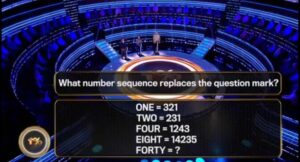
Players are presented with:
ONE = 321
TWO = 231
FOUR = 1243
EIGHT = 14235
FORTY = ?
The task is simply to work out which sequence of digits should replace the question mark.
There is no advanced mathematics involved, no specialist knowledge required and no complicated calculation to perform. Instead, the answer depends on noticing one subtle rule hidden inside the words themselves.
Give yourself 30 seconds before reading on.
The numbers are designed to send you in the wrong direction

The obvious instinct is to start looking for a numerical pattern.
Why does ONE become 321? Is there a relationship between the value of the number and the digits beside it? Does TWO becoming 231 reveal some kind of formula?
Then things become even more confusing.
FOUR produces four digits — 1243 — while EIGHT becomes 14235.
You might start counting letters, comparing the values of one, two, four, eight and forty, or trying different mathematical operations.
But that approach misses the key detail.
Despite appearances, this isn’t really a maths puzzle at all.
The numbers are describing something about the letters.
ONE contains the first major clue
@1percentclubitv Solve the puzzle… 🧩 #The1PercentClub #quiztime #quiztok ♬ original sound – The 1% Club
Start with the simplest example:
ONE = 321
Now forget that ONE represents the number one and instead treat it purely as a three-letter word.
Its letters appear as:
O – N – E
The digits 3, 2 and 1 correspond to those three letters according to one extremely familiar ordering system.
Still not seeing it?
Try arranging the letters differently.
Once the rule behind ONE becomes clear, the second example provides an immediate way to test whether you’ve cracked it.
TWO confirms the pattern
The next line reads:
TWO = 231
The letters are:
T – W – O
Whatever rule produced 321 from ONE must now give T a value of 2, W a value of 3 and O a value of 1.
There is no multiplication, addition or hidden numerical sequence connecting the examples.
Instead, think about how those three letters would be ordered in a dictionary.
That is the breakthrough.
FOUR and EIGHT follow exactly the same rule

The longer words may initially make the puzzle appear more complicated:
FOUR = 1243
and
EIGHT = 14235
But once the underlying principle has been identified, both sequences fall neatly into place.
Every digit represents the position each letter would occupy if all the letters within that particular word were placed in alphabetical order.
The digits are then written back alongside the letters in their original order.
That means this is essentially a word puzzle disguised as a numerical one.
And the final word contains an especially neat twist.
Can you solve FORTY before seeing the answer?

Now return to:
FORTY = ?
The letters are:
F – O – R – T – Y
Using exactly the same rule as the previous examples, each letter needs to be given its alphabetical ranking within the word.
If you’ve spotted what is unusual about FORTY, the solution may already be obvious.
If not, arrange its five letters alphabetically.
The answer is 12345
The hidden rule becomes easiest to demonstrate using ONE.
Its letters are:
O – N – E
Alphabetically, they would appear:
E – N – O
So within that word:
E = 1
N = 2
O = 3
Return those rankings to the original spelling, O-N-E, and you get:
3 – 2 – 1
Therefore:
ONE = 321
The same method works for TWO.
Alphabetically:
O – T – W
So O ranks first, T second and W third.
Returning to the original order T-W-O gives:
2 – 3 – 1
Therefore:
TWO = 231
For FOUR, its letters alphabetically become:
F – O – R – U
The original spelling F-O-U-R therefore carries the rankings:
1 – 2 – 4 – 3
So:
FOUR = 1243
EIGHT follows the same pattern. Its letters alphabetically are:
E – G – H – I – T
Returning those rankings to E-I-G-H-T produces:
1 – 4 – 2 – 3 – 5
Therefore:
EIGHT = 14235
And then comes the simplest part of the entire puzzle.
FORTY is already arranged alphabetically:
F – O – R – T – Y
That makes F first, O second, R third, T fourth and Y fifth.
So the missing sequence is:
FORTY = 12345
No equation was ever needed.
The real difficulty was recognizing that a puzzle dressed up as a number problem was actually testing something completely different: the alphabetical position of the letters inside each word.